

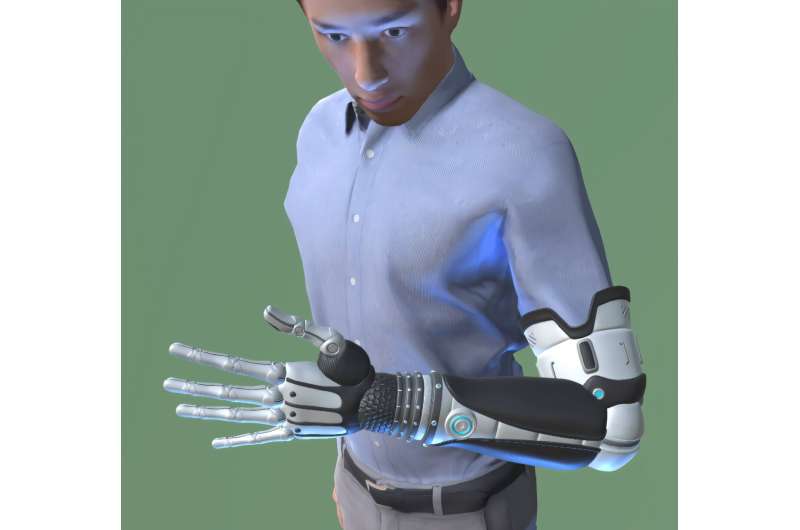
A recent study reported on Tech Xplore explores how people perceive autonomous prosthetic arms and what design choices make them feel more like part of the body rather than a foreign tool. Scientists at Toyohashi University of Technology used virtual reality to simulate a scenario in which a person’s forearm was replaced by an AI-driven prosthetic limb and measured how movement speed affected body ownership, sense of agency, usability, and how users socially perceived the device. The researchers found that moderate speeds close to natural human motion produced the strongest sense of embodiment and acceptance, while movements that were too fast or too slow reduced both the feeling of ownership and perceived usability.
Traditional prosthetics rely on direct control from the user, for example, electromyography or electroencephalography signals, and focus on accuracy and responsiveness. But advances in machine learning are making it feasible for future prostheses to provide autonomous or semi-autonomous assistance by interpreting context and acting without constant direct commands. As autonomy increases, so does the risk that a limb will feel “unsettling” or foreign if its actions occur at speeds that do not match users’ biomechanical expectations.
In the experiment, participants performed reaching tasks with the simulated prosthetic arm at various speeds. When the robotic motion lasted around one second, a pace similar to natural human reaching, users reported higher body ownership, greater sense of agency, and improved usability compared with very fast or very slow motions. These moderate movement speeds also produced higher impressions of competence and lower levels of discomfort.
The findings suggest designers of autonomous prosthetic systems should balance performance with perceptual comfort. In addition to movement speed, future work will examine how adaptation through long-term use may further shape users’ acceptance of robotic limbs. If a prosthetic is used continuously in everyday life, it may eventually feel more “normal” and integrated into the body over time, even when it performs autonomously.
