

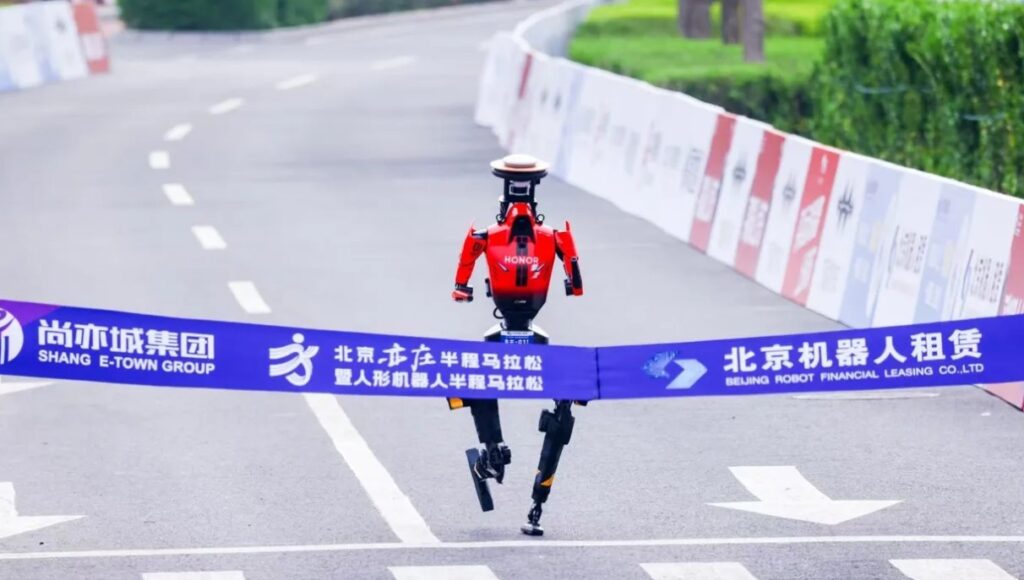
An even more striking development has matched a new milestone in human endurance in robotics. While elite runners have finally approached the long-sought sub-two-hour marathon under controlled conditions, a humanoid robot has shattered expectations by outperforming humans in a half-marathon. The Live Science article highlights this contrast to show how rapidly robotic capabilities are advancing.
At the 2026 Beijing E-Town Humanoid Robot Half-Marathon, an autonomous robot developed by Chinese company Honor completed the 21.1-kilometer course in just 50 minutes and 26 seconds. This time not only surpassed other robots but also beat the human world record of 57 minutes and 20 seconds, set by Ugandan runner Jacob Kiplimo.
The performance represents a dramatic leap from just a year earlier, when the fastest robot required more than two and a half hours to finish the same distance. Improvements in locomotion, balance, and energy management have driven this progress. The robot’s design includes long, humanlike legs optimized for stride efficiency, along with a liquid-cooling system adapted from smartphone technology that prevents overheating during sustained high-speed motion.
Equally important is the robot’s autonomy. Unlike earlier prototypes that relied on remote control, the latest systems use onboard sensors, real-time feedback loops, and AI-driven navigation to maintain stability and direction throughout the race. These advances enable robots to operate under dynamic conditions, such as uneven terrain and sustained physical stress.
Despite the achievement, the article notes that robots are not yet direct competitors to humans in sport. Many still struggle with reliability, requiring assistance or failing to complete races. Instead, these events serve as testing grounds for broader applications, including disaster response, logistics, and industrial mobility.
The result underscores a larger trend: robotic systems are rapidly closing the gap between laboratory prototypes and real-world performance. As machines become faster, more autonomous, and more resilient, their capabilities may soon extend well beyond controlled demonstrations into everyday environments.
