

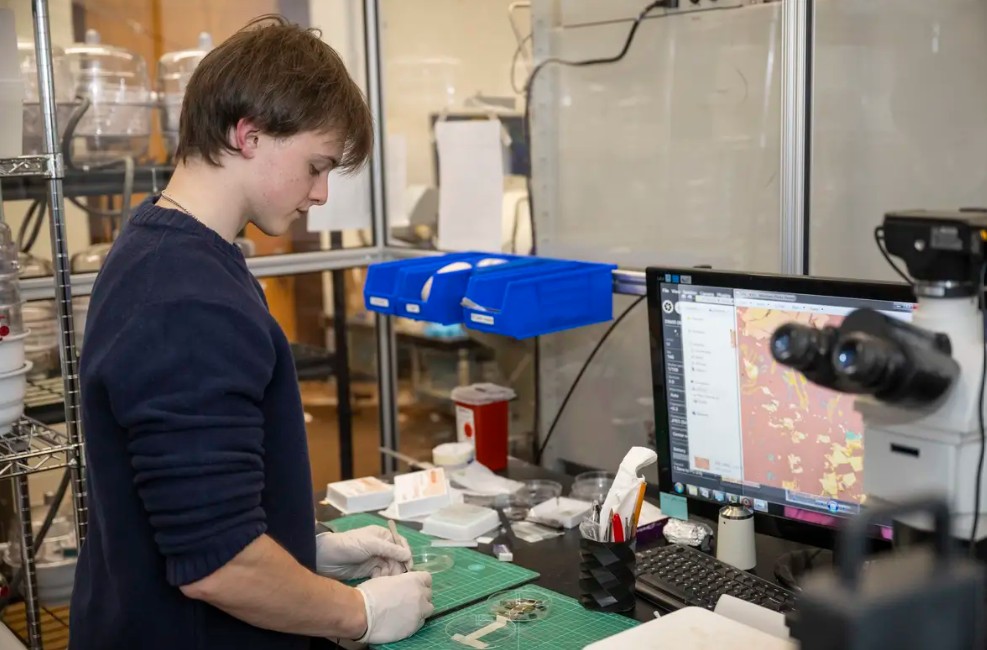
Carnegie Mellon University student researchers are tackling one of nanoscale science’s most tedious tasks, locating atom-thin two-dimensional materials, by merging quantum physics, robotics, and artificial intelligence into an automated system. The work stems from a Summer Undergraduate Research Fellowship (SURF) awarded to junior Patrick Kaczmarek, who is majoring in applied physics and mechanical engineering. His goal is to reduce the hours of manual searching that researchers currently spend under microscopes hunting for tiny flakes on glass slides.
Two-dimensional materials, sometimes called “flat LEGOs” because they can be stacked to engineer new properties, have enormous potential for use in high-speed electronics, superconductors, ultrasensitive sensors, and other advanced devices. But many of these materials exist as monolayers only a single atom thick, making them effectively invisible to the naked eye and extremely difficult to locate on a slide. Traditionally, graduate students sift through images manually, a slow and labor-intensive process.
Kaczmarek’s system combines a motorized microscope, robotic arm, and a machine learning algorithm known as a Gaussian mixture model. The setup scans slides inside a controlled glove box, a sealed environment that protects sensitive materials from air and moisture, identifying and categorizing flakes by thickness and area without human supervision. The system flags candidate monolayers that are most suitable for fabrication and further study, freeing researchers from repetitive, painstaking tasks.
The project lets Kaczmarek apply both his physics background and engineering skills, bridging fundamental science with practical tool development. He hopes to continue into doctoral research in nanoscale fabrication. The SURF program supports student innovation with summer stipends and hands-on research opportunities, and this work highlights how automation can accelerate discovery in fields where what you’re looking for is nearly invisible.
