

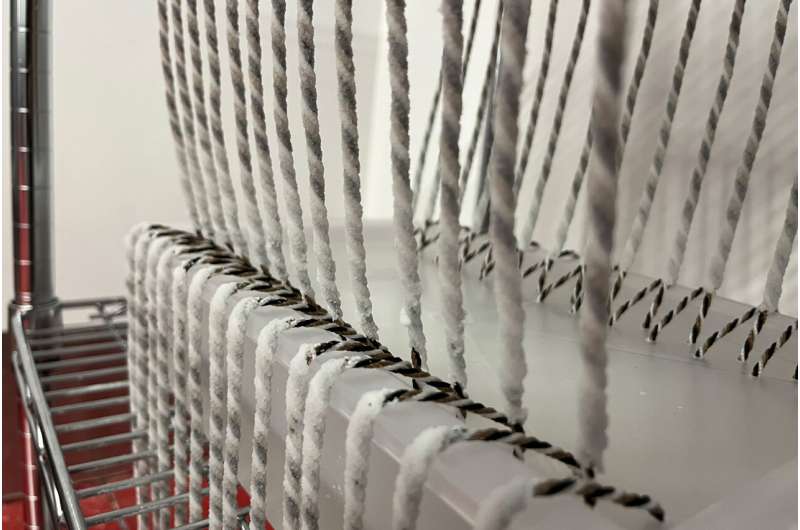
Researchers at the University of Toronto have introduced a new method, dubbed “evaporative carbonate crystallization,” that could make direct-air carbon capture far simpler and cheaper, tells Tech Xplore. The process relies on common polypropylene fibers that wick up a potassium-hydroxide solution; as ambient air flows by, water evaporates, concentrating the solution until it crystallizes nearly pure potassium carbonate, a CO₂-rich salt.
Unlike conventional systems that require energy-intensive fans and complex liquid regeneration (often using calcium to precipitate carbonate), this approach uses passive forces: capillary action to draw the liquid up the fibers and natural air movement for evaporation and crystallization. That yields a solid carbonate “rock candy” rather than a dilute solution, making CO₂ capture more efficient and regeneration simpler.
That change matters. Existing direct-air capture systems often struggle with cost and energy overhead, especially due to the need for large blowers and chemical regeneration cycles. The new method sidesteps both. A techno-economic analysis suggests capital costs could drop by as much as 40% if this technology scales.
Once captured, the potassium carbonate can be rewetted, releasing CO₂, which can then be stored underground or used to produce carbon-based fuels and chemicals. The underlying potassium hydroxide is regenerated in the process and reused.
Challenges remain. Performance depends on air humidity and drying conditions, so the method works best in relatively dry climates or with appropriate airflow. And scaling this from lab prototype to industrial deployment will require building and testing pilot-scale systems.
Still, this “rock candy” technique reopens a simpler path toward direct-air CO₂ removal, one based on cheap materials, passive physics, and lower engineering overhead. This could shift carbon removal technologies from exotic labs toward scalable real-world use.
