

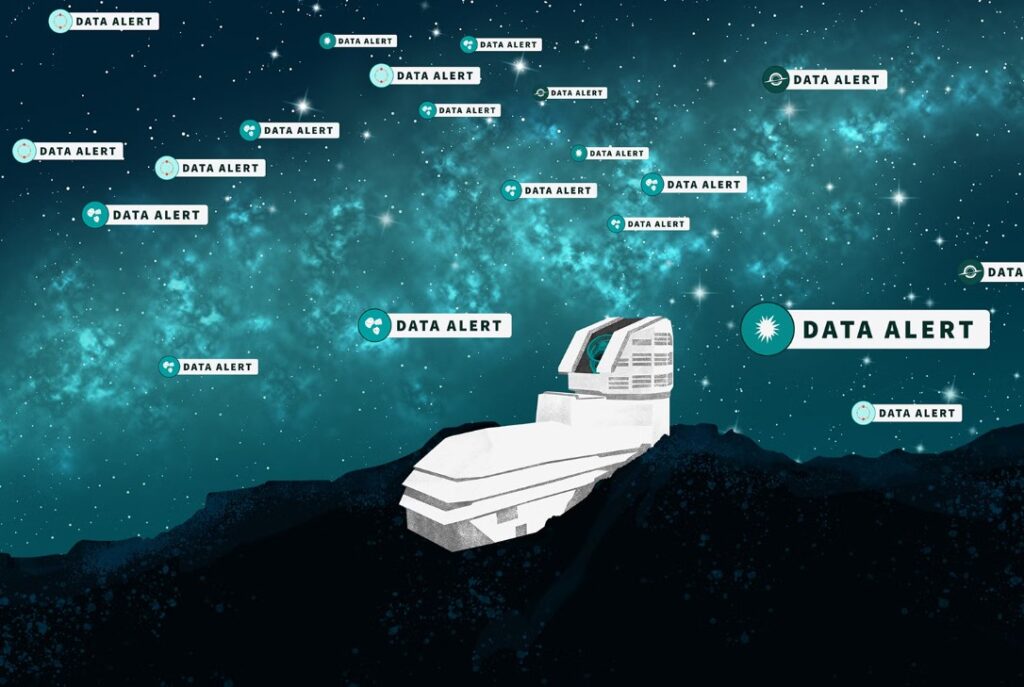
The NSF-DOE Vera C. Rubin Observatory has begun issuing real-time alerts that flag changes in the night sky, marking a major milestone before the start of its Legacy Survey of Space and Time (LSST) later in 2026. On the night of February 24, the system generated about 800,000 notifications pointing researchers toward supernovae, variable stars, active galactic nuclei, and asteroids moving through the solar system. These alerts signal anything that has changed since the observatory last scanned a portion of the sky, including objects that brighten, dim, or move in position. The alert stream is expected to grow to as many as 7 million per night once LSST is fully operational, tells Stanford Report.
Rubin’s alert pipeline compares each new image with a reference image to detect changes in brightness or position. Within minutes of capturing an image, the system automatically generates alerts that are made public, enabling astronomers around the world to plan follow-up observations with other telescopes. This near-real-time responsiveness is designed to catch transient events early, such as the early light from supernova explosions or fast-moving near-Earth objects, giving researchers crucial time for detailed study.
The alerts will support a wide range of research areas in astronomy and astrophysics. By providing a continuous, high-volume stream of change notifications, Rubin will let scientists track and study dynamic phenomena across the cosmos at an unprecedented scale. The observatory’s large digital camera will capture images covering the Southern Hemisphere sky nightly for 10 years, building an extensive time-lapse record of the universe and enabling discoveries that weren’t possible with earlier telescopes.
Beyond detecting dramatic events, the alert system opens doors for coordinated global science. Researchers can use the information to trigger targeted observations with ground-based or space-based observatories, creating opportunities for rapid, multi-instrument investigations of transient events that shed light on fundamental astrophysical processes.
