

Designing safe interactions between pedestrians and self-driving cars has largely focused on walkers. New research highlighted in the Tech Xplore article shows that this assumption misses a critical group: runners, whose behavior introduces new risks and complexities for autonomous systems.
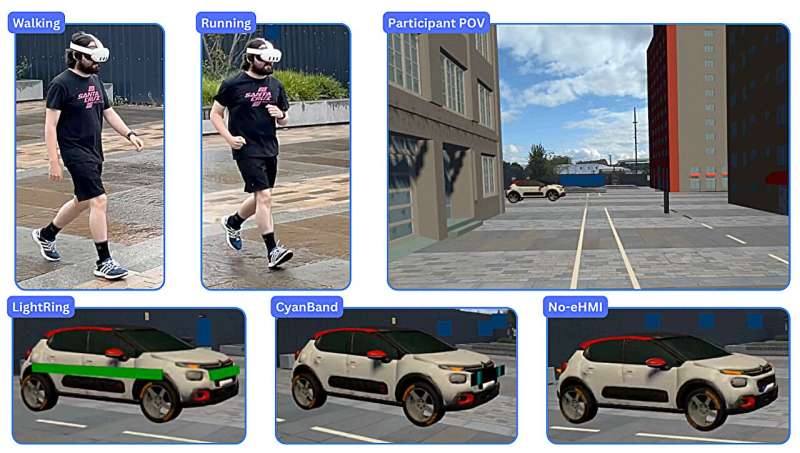
The study, conducted by researchers from the University of Glasgow and KAIST, used augmented reality to simulate real-world road crossings. Participants either walked or ran toward a junction while interacting with a virtual autonomous vehicle. The results revealed clear behavioral differences. Runners were significantly more likely to take risks, often choosing to continue moving rather than slowing down to assess traffic conditions.
This urgency stems from both physical and cognitive factors. Maintaining pace requires effort, and runners are less inclined to stop and restart. As a result, they spend less time evaluating their surroundings and are more prone to misjudging vehicle speed or intent. In the simulations, runners were even “hit” by virtual vehicles in several cases, while walkers avoided collisions entirely.
The findings highlight a gap in how autonomous vehicles are currently trained. Most systems assume cautious pedestrian behavior, which aligns more closely with walkers than runners. To address this, researchers explored the use of external human-machine interfaces, or eHMIs, such as light signals on vehicles that communicate intent. Participants found these signals helpful, but runners often relied on them too quickly, sometimes ignoring contradictory cues from vehicle motion.
To improve safety, the team proposes new interface designs, including a “DualBeam” lighting system that uses distinct colors to indicate whether a vehicle will yield. They also suggest integrating alerts into wearable devices such as smartwatches or earbuds, giving runners early warnings without forcing them to slow down.
The research underscores a broader challenge for autonomous driving. Roads are shared with diverse users whose behaviors vary widely. Accounting for these differences, especially among faster-moving pedestrians, will be essential for building systems that can operate safely in real-world environments.
