

Training an autonomous driving system is less about writing rules and more about teaching a machine to learn from experience. The article from the Engineering Blog by General Motors explains how General Motors is rethinking this process by combining large-scale simulation, real-world data, and advanced AI models to dramatically accelerate development.
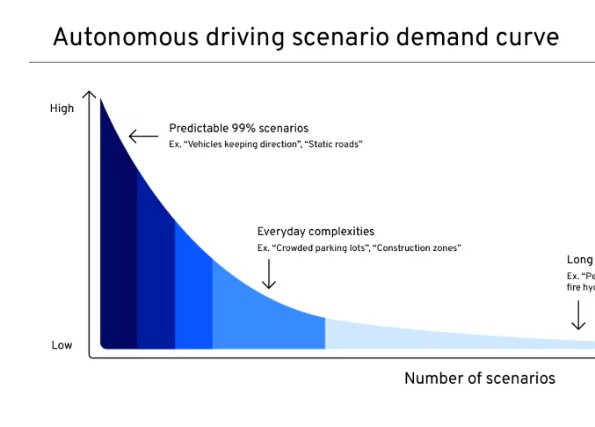
At the center of GM’s approach is the concept of training driving AI far faster than real time. Instead of relying solely on physical testing, which is slow and limited, GM uses simulation environments where vehicles can experience millions of virtual scenarios. These simulations run at speeds up to tens of thousands of times faster than real-world driving, allowing the system to encounter rare or dangerous situations that would take years to observe on actual roads.
Reinforcement learning plays a critical role in this process. The AI learns by making decisions, receiving feedback, and improving through repeated trials. In simulation, this cycle can be compressed dramatically, enabling rapid iteration and refinement. However, simulation alone is not enough. GM integrates real-world driving data to ensure the system remains grounded in actual conditions, creating a feedback loop between virtual and physical environments.
Another key element is the use of foundation models, which allow the system to generalize across different driving scenarios. Rather than training separate models for each task, GM is building unified systems capable of perception, prediction, and decision-making. This reduces complexity while improving scalability across vehicle platforms.
The challenge lies in balancing speed with safety. Autonomous systems must not only learn quickly but also behave reliably in unpredictable environments. GM’s strategy focuses on increasing the “learning rate” of the system while maintaining rigorous validation standards, ensuring that improvements translate into safer performance on the road.
This approach reflects a broader shift in automotive engineering. Training AI has become a central engineering discipline, where simulation, data, and machine learning converge. By accelerating how quickly systems learn, GM aims to bring advanced autonomy closer to real-world deployment, redefining the pace of innovation in vehicle intelligence.
