

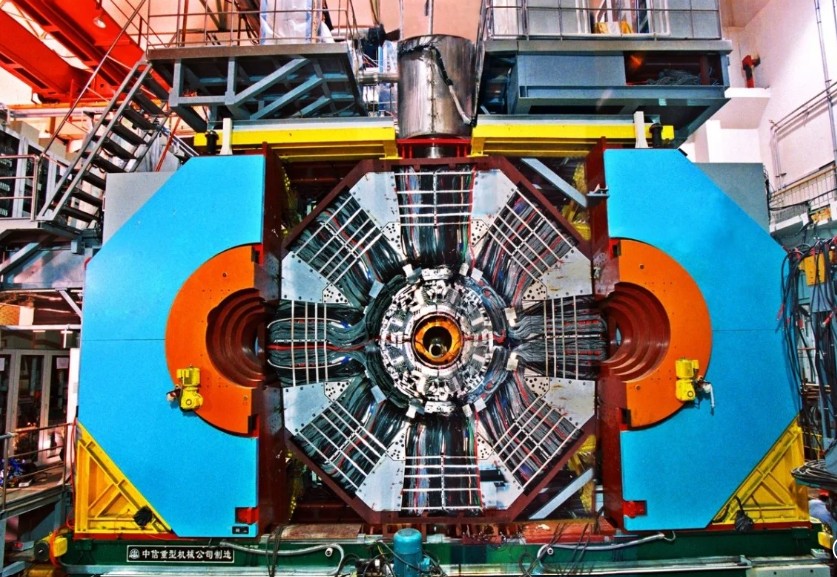
A Chinese-led international research team has reported evidence for the existence of the glueball, an unusual particle made entirely of gluons, the carriers of the strong nuclear force. The finding follows 15 years of research using the Beijing Electron Positron Collider II and addresses a prediction that particle physicists have pursued for about half a century, tells this South China Morning Post article.
The results were announced at the International Conference on High Energy Physics in Natal, Brazil. The research collaboration includes approximately 700 scientists from 15 countries. Their work centers on a particle called X(2370), which researchers have studied since its discovery in 2011.
Gluons normally bind quarks together to form particles such as protons and neutrons. Unlike photons, which carry the electromagnetic force but do not interact directly with one another, gluons can interact with themselves. This property led physicists to predict that gluons could bind together without quarks, creating particles known as glueballs. Finding experimental evidence has remained difficult because potential glueball signatures can resemble those of conventional particles.
Researchers used the collider to accelerate electrons and positrons to nearly the speed of light and smash them together. These collisions produced J/psi particles, whose decays create conditions rich in gluons and therefore provide a promising environment for detecting glueballs.
Recent measurements have strengthened the case for X(2370). Studies of its mass, spin-parity characteristics, production rate, and decay behavior indicate that its properties closely match theoretical predictions for the lightest pseudoscalar glueball. Researchers also found evidence that X(2370) behaves as a flavor-singlet state, strengthening the interpretation that a glueball is its dominant constituent.
The result provides an important experimental test of quantum chromodynamics, the theory describing interactions involving quarks and gluons. It also offers physicists a new opportunity to study the unusual behavior of the strong force and better understand the fundamental structure of matter.
