

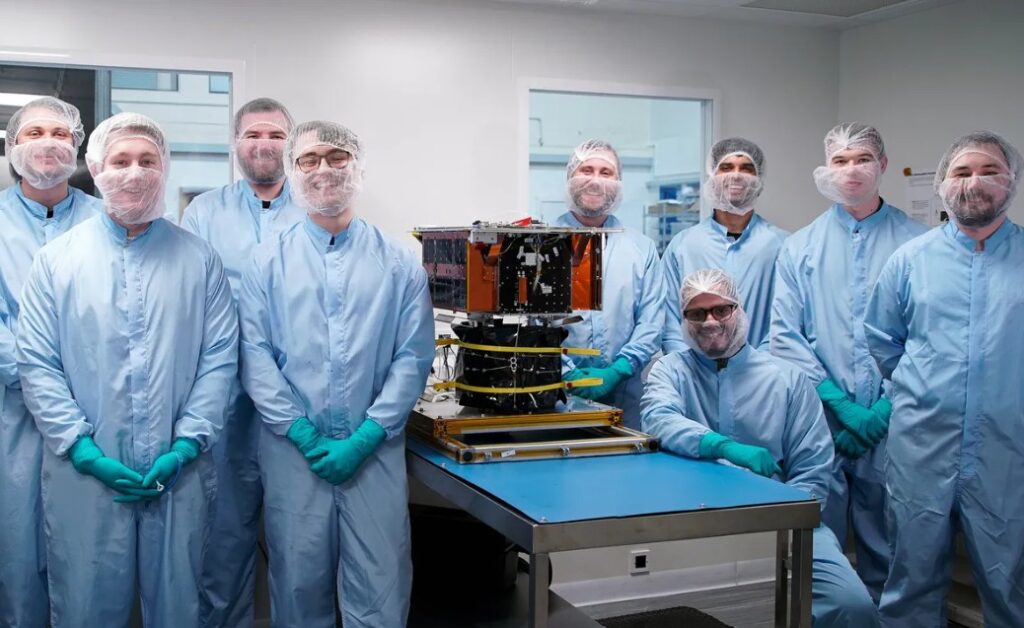
A recent article in IEEE Spectrum highlights early successes and future promise of in-orbit manufacturing, using space’s unique environment to make materials and products that are difficult or impossible to produce on Earth. The focus is on a British startup, Space Forge, that recently operated an orbital furnace aboard its ForgeStar-1 satellite to create super-hot plasma and begin growing high-purity crystal seeds in space. These tiny crystals could become the foundation for semiconductor substrates such as gallium nitride or silicon carbide once they return to Earth. Microgravity and the ultra-high vacuum of low Earth orbit reduce impurities and convection, allowing crystals to form more uniformly than under terrestrial conditions. Early research shows space-grown crystals can be larger, more uniform, and potentially more efficient in electronics than Earth-grown equivalents.
Space Forge’s first mission is experimental: it will not return the crystals to Earth, and the satellite itself will burn up on reentry. The company plans a follow-up mission to bring back a small amount of material for testing. Space Forge and several other emerging companies are exploring similar pathways. Colorado-based Voyager Technologies has patented methods for orbitally growing novel fiber-optic materials that could boost data transmission. London-based ACME Space plans to test a balloon-launched orbital factory called Hyperion. Varda Industries, based in California, has raised substantial funding and conducted multiple orbital flights to test space-manufacturing of pharmaceuticals.
Analysts estimate the in-orbit manufacturing market could grow into a multibillion-dollar industry by the early 2030s. Advocates argue that the inherent advantages of microgravity and vacuum environments, such as reduced defects and improved material properties, may yield products that outperform their Earth-made counterparts in fields from advanced computing to optical networks and drug research. At the same time, challenges remain: high launch and return costs, technical risk, and questions about whether the performance improvements will offset those costs in commercial markets.
