

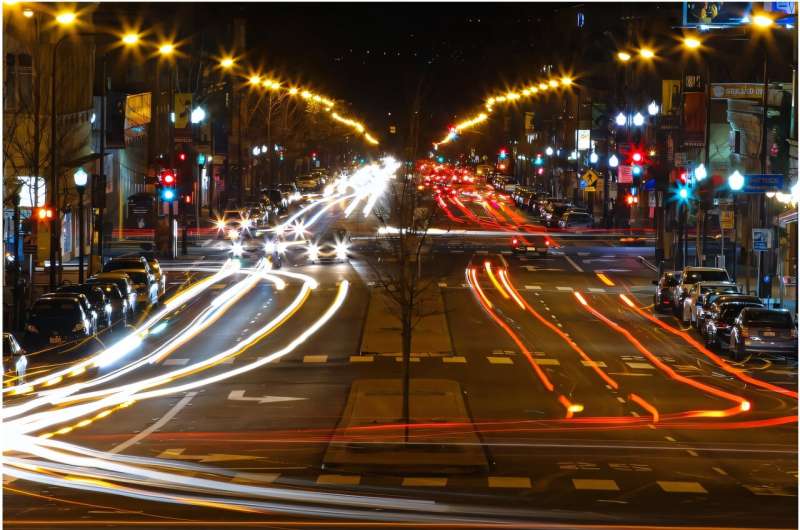
Researchers have developed a camera-based system that can detect faraway vehicles with far greater accuracy than existing methods, offering a practical way to make intersections and roads safer for drivers and pedestrians. The work, published in the IEEE Open Journal of Intelligent Transportation Systems, tackles a persistent blind spot in many vehicle surveillance systems: distant objects often appear too small or unclear for standard detection algorithms to recognize reliably. By smartly expanding the field of view and using motion cues, the new method improves distant vehicle detection by more than double the accuracy of conventional systems, tells Tech Xplore.
Most current vehicle detection approaches depend on deep learning models that need powerful computing and massive training datasets, yet they still struggle with far-off targets. The new technique takes a different tack. It begins by analyzing nearby vehicle motion from continuous video footage to estimate the road’s vanishing point, the point where the roadway appears to converge on the horizon. Once this distant region is identified, the system digitally enlarges it so that even small, faraway vehicles become visible to the detection model. A Gaussian Mixture Model then identifies moving vehicles in this enhanced view, helping catch cars that would otherwise go unnoticed.
In testing under both daytime and nighttime conditions, the innovation ran smoothly at 30 frames per second on modest hardware like a Raspberry Pi or Jetson Nano, outperforming some heavier deep-learning systems without the need for high-end computing. That opens the door for low-cost deployment at intersections, on traffic lights, or in roadside cameras.
The researchers envision this technology as part of intelligent transportation systems that deliver real-time alerts to drivers and pedestrians, potentially interfacing with connected devices or traffic signals to warn of approaching vehicles. Future work may explore performance in adverse weather and expand classification abilities for vehicle types, further enhancing safety infrastructure.
