

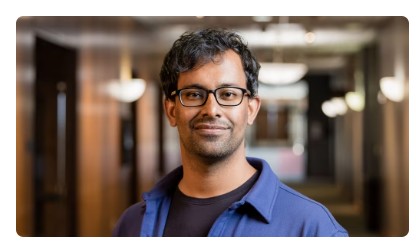
Dhananjay Bhaskar has an eye for creativity, even in data. On a video call from Yale’s Wu Tsai Institute, he stopped to show off a lenticular print—one that ripples and shifts as you move. It’s not just a visual trick; the image traces back to brain scans of people imagining Yale’s campus, decoded with AI. It’s art, yes, but also a proof of concept. Bhaskar and collaborators see it hinting at future uses in neuroscience and clinical care, such as interpreting mental imagery in infants or helping patients communicate when words fail, according to the College of Engineering, UW-Madison.
In fall 2025, Bhaskar brings that blend of science and creativity to UW-Madison, joining the biomedical engineering faculty under the RISE-AI Initiative. His toolkit includes topological data analysis, machine learning (ML), and mathematical modeling. He aims to decode the “shape” of data, geometric signatures that might advance drug discovery, cancer biology, neuroscience, and more.
Bhaskar traces his journey back to his undergraduate years at the University of British Columbia, where he discovered mathematical biology. For his PhD at Brown University, he dove into cancer biology: modeling how healthy tissue turns malignant. He drew inspiration from M.C. Escher, a famous Dutch graphic artist for blending math and art, by focusing not just on cell clusters, but on the empty spaces between them. Those gaps, he discovered, tell just as much about how cancer develops.
Post-PhD, at Yale School of Medicine, Bhaskar delved into machine learning. One project, among others, used ML to interpret brain activity in individuals with schizophrenia, offering better insights even with limited patient data. It’s a method that doesn’t just crunch numbers; it understands their shape.
At UW-Madison, Bhaskar plans to develop new courses—machine learning for bioengineers and cell-systems modeling—and is already collaborating on brain calcium-signaling research. He says his strength lies in speaking both the language of biologists and the technical grammar of geometry and topology. In his words, he builds tools that “let us see what we couldn’t before—the hidden structures that make biology work.”
