

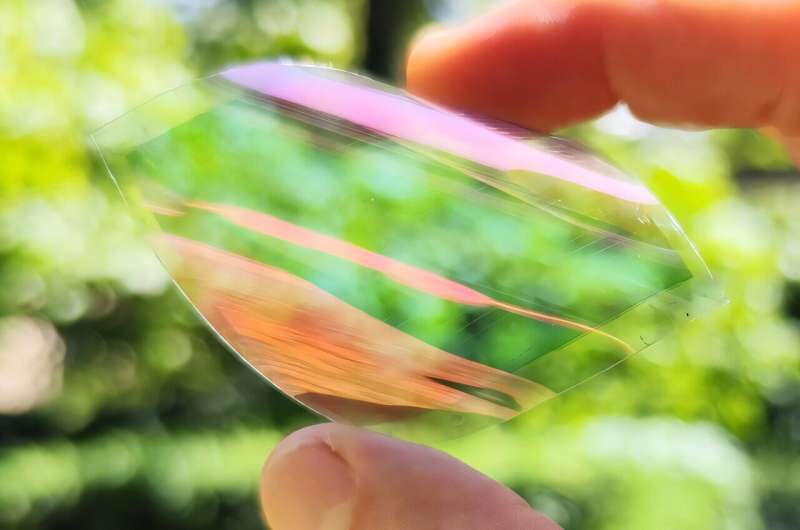
Researchers at the University of Freiburg and Fraunhofer Institute for Solar Energy Systems ISE have developed scalable semitransparent organic photovoltaic modules that could eventually transform windows, glass facades, greenhouses, and vehicle roofs into electricity-generating surfaces. The modules combine transparency with energy generation while using manufacturing processes suited to larger-scale production, tells Tech Xplore.
The researchers produced 14.5 × 14.5 centimeter modules with an average visible-light transmittance of 43.2% and power conversion efficiency reaching 9.26%. Their light utilization efficiency, a measure reflecting the balance between transparency and photovoltaic performance, reached 4.0%.
Scaling organic photovoltaics has been difficult because techniques that produce strong results with small laboratory cells do not necessarily translate to larger modules. The team addressed this problem using sputtering and slot-die coating, two established manufacturing processes. All solar-cell layers handled through slot-die coating were deposited with virtually no loss during scale-up.
Each module contains more than 100 solar cells interconnected through laser structuring. The cells incorporate a near-infrared-reflecting back electrode, an organic semiconductor absorber, and a metal-free PEDOT:PSS polymer top electrode. A newly developed PEDOT:PSS formulation helped improve module transparency.
The manufacturing approach also supports flexible photovoltaics. Because slot-die coating is compatible with roll-to-roll production, researchers fabricated organic solar modules on film. These flexible modules retained 100% of their initial efficiency after 1,274 bending cycles around a 15-millimeter-diameter rod.
The researchers believe transparency can be increased further without sacrificing efficiency. Modules transmitting well above 50% of visible light could potentially replace conventional glazing in certain building facades and greenhouses. Lower-transparency versions could suit applications where tinted glass is preferred, including vehicle roofs. The next challenge is increasing the area of flexible modules while maintaining their performance and manufacturability.
