

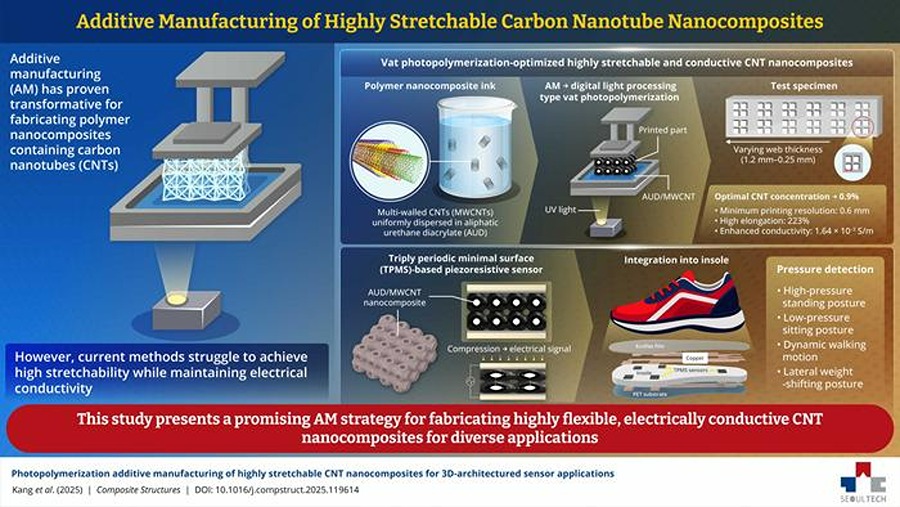
Polymer-based conductive nanocomposites are emerging as key materials for flexible electronics, soft robotics, and wearable devices, however CNTs remain difficult to process because they clump together and resist uniform dispersion. Conventional fabrication methods also restrict control over nanotube distribution and shape. To address these challenges, researchers are exploring additive manufacturing (AM) techniques such as vat photopolymerization (VPP), which provides design flexibility and printing accuracy. In this method, a light is used to harden layers of an ink within a vat, gradually building a 3D object.
A research team led by professor Keun Park and associate professor Soonjae Pyo from the department of mechanical system design engineering at Seoul National University of Science and Technology (SeoulTech) in Korea has fabricated stretchable, electrically conductive CNT-nanocomposites, using VPP-type 3D printing. “Our new CNT-nanocomposites are optimized specifically for VPP-based processes, allowing fabrication of highly complex 3D structures,” explains Prof. Park. “We also used these materials to additively manufacture new piezoresistive sensors and integrated them into a wearable health monitoring device.” Their study was made available online on August 25, 2025 and published in the Volume 372 of the journal Composite Structures on November 15, 2025.
The team prepared nanocomposite inks by dispersing multi-walled carbon nanotubes (MWCNTs) into an aliphatic urethane diacrylate (AUD) resin at 0.1 to 0.9 weight %. They used ultrasonic agitation to achieve uniform dispersion and then analyzed the inks to identify the optimal printing conditions.
The team used the prepared inks to 3D print test specimens. They measured mechanical strength, electrical conductivity, and printing resolution. The 0.9 weight percent CNT formulation showed the best performance. It stretched up to 223% of its length before breaking and maintained conductivity of 1.64 × 10⁻³ S/m. This formulation also achieved a minimum printing resolution of 0.6 millimeters.
The researchers used the CNT nanocomposite to 3D print sensors based on triply periodic minimal surface (TPMS) structures. These piezoresistive sensors showed high sensitivity and performance. They integrated the sensors into an insole to create a smart-insole platform. The system monitored foot pressure and detected changes in movement and posture.
“The developed smart-insole device demonstrates the potential of our CNT nanocomposites for 3D printing the next generation of highly stretchable and conductive materials,” remarks Prof. Pyo, “We believe these materials will be indispensable for wearable health monitors, flexible electronics and smart textiles.”
Source: SEOULTECH
About Seoul National University of Science and Technology (SeoulTech)

Seoul National University of Science and Technology (SeoulTech), founded in 1910, is a national research and teaching university located in Seoul, Korea. The university enrolls about 13,000 undergraduates and 1,800 graduate students. It offers programs through colleges and graduate schools in engineering, information and communication engineering, energy and biotechnology, art and design, humanities, and business. SeoulTech also operates professional graduate schools, research centers, and international partnerships that serve industries such as manufacturing, information technology, semiconductors, energy, design, and public policy. The campus includes research and incubation facilities that support both education and applied research.
