

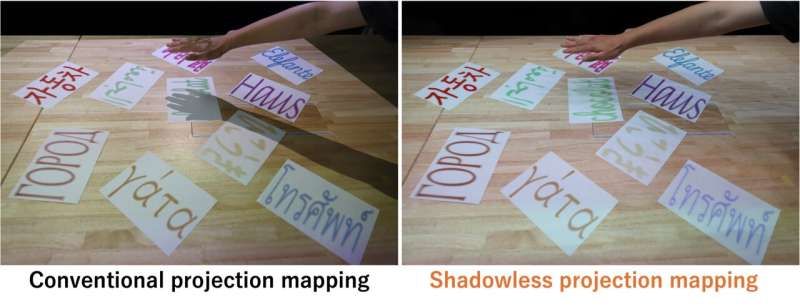
Researchers in Japan have developed a projection technology that challenges a long-standing limitation of visual systems: the inability to make projected images appear as part of a physical object. Their approach, called shadowless projection mapping, removes key visual cues that typically reveal an image as a projection, allowing it to be perceived instead as a change in the object’s actual material or surface, tells Tech Xplore.
Conventional projection mapping overlays images onto surfaces, but human perception easily distinguishes these overlays from real materials. Shadows, occlusions, and directional lighting expose the illusion. For example, when a person blocks a projector, the image disappears or distorts, reinforcing the sense that it is separate from the object.
The research team, led by Daisuke Iwai at the University of Osaka, addressed this problem by eliminating shadows entirely. Their system uses multiple projectors arranged in a synthetic aperture configuration, ensuring that projected light reaches the surface from many directions simultaneously. As a result, even when parts of the projection are obstructed, the image remains visible, mimicking the behavior of real-world surface properties.
This seemingly subtle change has a profound effect on perception. Without shadows or occlusion artifacts, viewers interpret the projection not as an overlay but as an intrinsic property of the object itself. Colors, textures, and patterns appear to belong to the material, effectively turning light into a convincing substitute for matter.
The implications extend beyond visual effects. The technology could support industrial design by enabling rapid visualization of material changes, enhancing remote collaboration by projecting shared information directly onto physical workspaces, and improving medical environments through intuitive data overlays.
Presented at the IEEE Conference on Virtual Reality and 3D User Interfaces, where it received a Best Paper Award, the work signals a shift in projection technology. By aligning optical behavior with human perception, shadowless mapping brings digital imagery closer to being indistinguishable from physical reality.
