

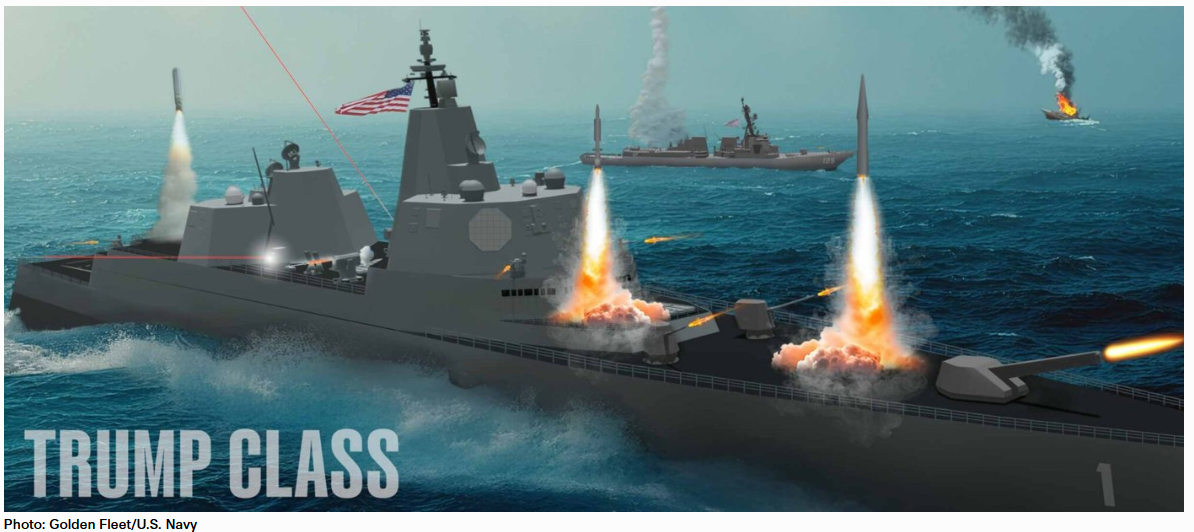
The Golden Fleet, proposed by US President Donald Trump, features a new “Trump-class” battleship.President Trump wants a Golden Fleet. The centerpiece: a “Trump-class” battleship.
“They’ll be the fastest, the biggest and by far 100 times more powerful than any battleship ever built,” Trump proclaimed at his Mar-a-Lago resort in Florida late last year.
Never mind that the US hasn’t constructed a battleship since World War II. Never mind that modern naval doctrine has spent decades moving away from big, slow, expensive surface ships, now seeing more as targets rather than weapons. And never mind that the Philadelphia Naval Shipyard, where the Golden Fleet ships are to be built, is now owned by a South Korean conglomerate.
America’s shipbuilding decline is real, documented and genuinely alarming for anyone who would wish for America to be, once again, a naval superpower. The same goes for those who wish some of the biggest commercial ships, the cargo ships and tankers we see in our ports and in the news, were made here. But the US builds roughly one percent of the world’s commercial ships. China accounts for 70% of global orders. South Korea and Japan split most of the rest. The three of them — China, South Korea and Japan — account for ninety-five percent of the entire shipbuilding industry.
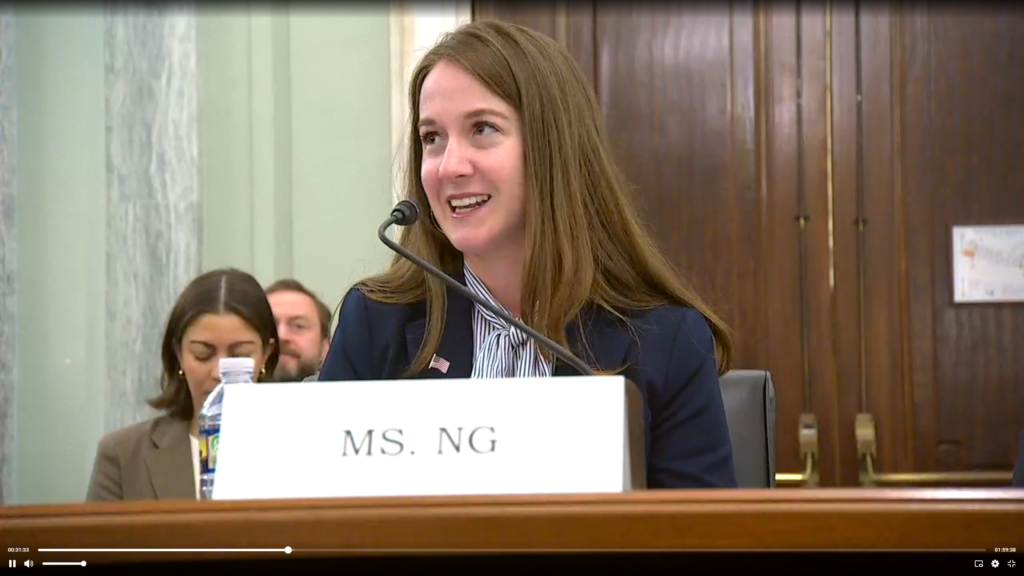
Into this shipbuilding gap sails Brittany Ng.
Brittany is Vice President of Siemens’ Maritime division — the part of Siemens Digital Industries Software that is staking a claim in the effort to rebuild American shipbuilding, as well as shipping worldwide, from the inside out.
We see Brittany for the first time when she appeared on Capitol Hill, testifying before the Senate Subcommittee on Science, Manufacturing and Competitiveness titled “Less Hype, More Help: AI That Improves Safety, Productivity and Care.” Ted Cruz, Republican senator from Texas, chairs the overarching Senate Commerce Committee and actually made it, though he arrived late and left early.
We wondered if Brittany would be in the hot seat, questioned on her provenance. Siemens is after all a German company. But Brittany was well prepared. She wore a US flag lapel pin. Had the senators’ staff checked out her LinkedIn profile, they would have seen the US flag behind her. Had they checked out her background, they would have found an American military tradition— albeit the US Air Force, not the UN Navy.
Brittany may not have served, but Siemens might argue her role at Siemens be considered a civilian form of service.
Brittany’s background is in management consulting at Deloitte, where she spent years architecting digital transformation programs for aerospace and defense, as well as life sciences and manufacturing.
So closely did her experience tie into Siemens Industry Software that she called Siemens directly and asked for a job. She got it.
“I felt like I had finally arrived at where I should have been,” she said on an ENGtechnica podcast. “I’d only been talking about the digital thread for about a decade.”
AI vs Jobs
How AI could help America in manufacturing, including shipbuilding, was front and center at the subcommittee hearing. So was the talent gap. So was the uncomfortable question every American is silently asking: Is AI going to take away my job?
It’s not a fair question, to be sure. Like sheep asking the wolf for the safe word.
Technology is quick to shout over such concerns and cite its advantages over the concerns of mere mortals.
Siemens makes a very good case for its technology — even with one data point. The most complex 3D model ever created is not a fighter jet or a semiconductor fab. It is a ship — built digitally by HD Hyundai using Siemens tools, visualized with NVIDIA, containing a bill of materials running into the millions of parts. The most famous big model before that: the Boeing 777, the first commercial aircraft to be modeled in 3D. That was 30 years ago.
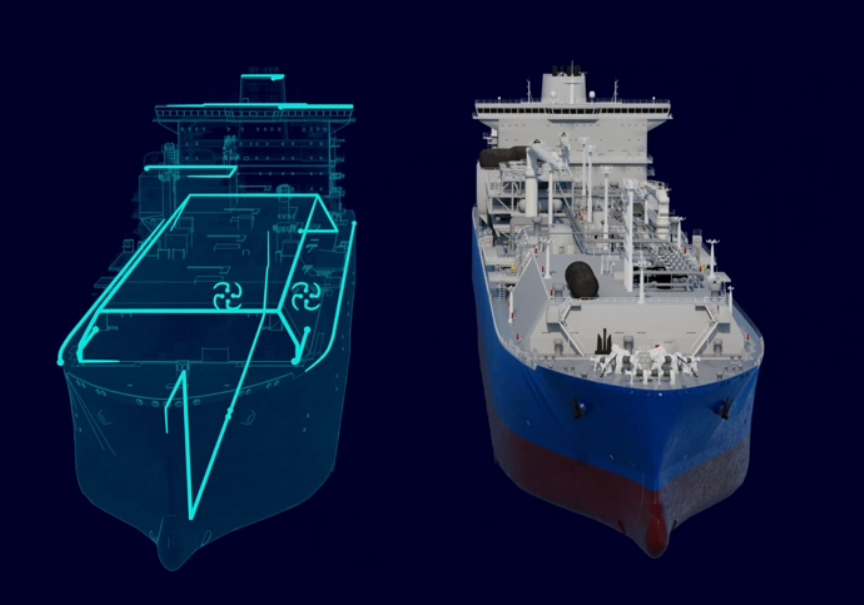
With software, a ship can take shape in 3D and in great detail before a single piece of steel is cut.
Siemens’ platform — Xcelerator, built around tools like NX and Teamcenter, bolstered by the acquisition of Mentor Graphics and augmented by the recent Altair acquisition — has created what is arguably the most complete multi-disciplinary design and simulation platform. Brittany calls “the digital backbone.” In addition to design and simulation, production planning, supplier coordination and quality control: all connected. The digital twin doesn’t just model the ship; it also models the shipyard. An interference, or clash, gets resolved in silicon before it becomes a problem in steel.
In her Senate testimony, Brittany put it plainly: “By resolving bottlenecks in the virtual environment first, the facility ramped up faster with greater precision and flexibility.” She was describing a Siemens factory in Fort Worth but that would apply just as well to a dry dock in Philadelphia.
Jobs. More or Less?
The workforce problem is where AI could provide the greatest advantage, says Brittany. American shipbuilding doesn’t just lack shipyards — it lacks shipbuilders. There are more than 400,000 open manufacturing jobs nationwide. Naval architects are in short supply. The skilled trades needed on the dry dock — welders, machinists, pipe fitters — are retiring faster than they are being replaced.
Brittany’s answer is not fewer workers. It’s the more capable ones. “We are in desperate need of more players on the field,” she told the podcast. “We need more naval architects, more people working for the shipbuilder OEMs. And we need loads more individuals actually in the back shops, on the dry docks,” she says.
What she doesn’t say, but we will: We need more AI agents.
Siemens All In for Industrial AI
Industrial AI, in Siemens’ framing, is a force multiplier — not a reduction in force. AI copilots embedded in design tools handle the tedious: updating bills of materials, flagging supplier alternatives, tracking drawing revisions. That should free engineers to do engineering. On the shop floor, AI improves first-time quality — reducing the rework that consumes hours, leads to burnout and inflates schedules. “Executing rework due to quality is typically not the top of the list of things that are on their enjoyment rating for their job,” she says.
I have to question the use of foreign firms to rebuild American shipbuilding. My first job offer out of engineering school was with the Philadelphia Naval Shipyard but I went to work for a defense contractor. Both jobs required a Secret clearance, which involved government people checking out your background, travel, national allegiances, relatives and associates. If the answers to all questions are “American,” it is clear sailing.
But the Philadelphia shipyard is now owned by a South Korean conglomerate.
Brittany doesn’t shy away from the question of foreign provenance. Shipbuilding is international now, and other countries are our allies in this field. She points to AUKUS, a multinational program (Australia, the UK and the US) to build submarines.
Siemens is making the case that the digital thread is key to the plan. The connected software infrastructure that enables the design, simulation and construction of complex vessels faster, more efficiently and with a smaller, more skilled workforce than America’s current industrial base can otherwise support.
In her Senate closing, Brittany borrowed an Einstein parable: the physicist searches frantically for his train ticket before the conductor, who assures him not to worry. He knows the man. Einstein’s reply — “I know who I am. What I don’t know is where I’m going.”
A parallel to Siemens, perhaps. Here is a company that knows it is a leader in industrial AI. What it doesn’t know is how to get the world to use it to get to where it needs to go.
