

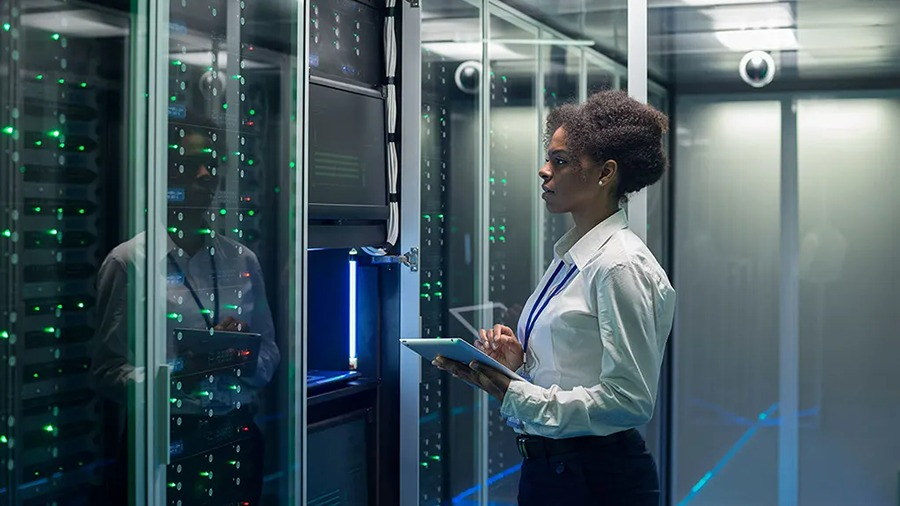
ZUG, Switzerland, Mar 19, 2026 – AI-driven demand for data center capacity is increasing pressure on power supply and grid access. Siemens Smart Infrastructure is responding with an investment in Emerald AI and a partnership with the company, along with integration of Fluence battery energy storage and physics-based AI modeling from PhysicsX. These additions support coordination between compute workloads and energy systems and improve grid connection timelines in constrained environments.
“Scaling AI infrastructure isn’t just a computing challenge, it is equally an energy and infrastructure challenge,” said Ruth Gratzke, President of Siemens Smart Infrastructure U.S. “As demand for AI processing accelerates, data center growth is increasingly constrained by grid capacity and interconnection timelines. Addressing this requires complex coordination across both the digital and energy domains. Siemens is actively investing in key technologies and partnerships to expand the ecosystem required to scale AI responsibly and support the next generation of data center infrastructure.”
Siemens is using Emerald AI to align data center demand with grid conditions by shifting AI workloads across time and location. The platform coordinates compute activity with onsite energy resources, reducing peak demand, lower strain on infrastructure, and speed grid connections. This investment in Emerald AI adds flexibility at the compute layer and supports IT/OT convergence between AI workloads and power systems through Siemens’ operational technology capabilities.
Fluence energy storage systems manage power delivery for large AI data centers by shaping load and controlling ramp rates. This improves predictability for utilities and supports grid connections in constrained locations. The systems also provide onsite, dispatchable power during build-outs, capacity limits, or outages.
Siemens is working with PhysicsX to extend its data center strategy into physics-based AI modeling for power distribution systems. The collaboration uses AI models trained on Siemens’ multi-physics simulation data to predict thermal behavior in busway systems in real time. Simulations that once took days now run in seconds, allowing faster design iteration for AI infrastructure.
AI growth is increasing variability in power demand, as training and inference clusters create rapid load changes. These patterns challenge grid planning and data center design. Siemens combines workload orchestration, energy storage, and physics-based modeling to manage these conditions.
Source: Siemens
About Siemens Smart Infrastructure

Siemens Smart Infrastructure, a division of Siemens AG, is headquartered in Zug, Switzerland. The division integrates energy systems, buildings and industrial processes to improve efficiency and support modern infrastructure needs. It provides HVAC controls, fire safety systems, security technologies, energy-performance services, grid-resilience tools and electric-vehicle charging equipment. Its offerings serve sectors such as data centers, energy and manufacturing. The division develops systems that span the energy value chain, from power generation to end use, and focuses on addressing challenges related to urbanization and climate change. It also places emphasis on cybersecurity to support secure and reliable operation in increasingly digital environments. Siemens Smart Infrastructure employed about 80,000 worldwide.
About Emerald AI

Emerald AI is a U.S.-based energy technology company that develops software to manage power use in AI data centers. Founded in 2024, it is headquartered in Washington, DC. Its main product, the Conductor platform, connects data centers with electric grids and adjusts computing workloads in real time. The platform supports AI training and inference while helping maintain grid stability. Emerald AI serves data center operators and utility companies that need to balance energy demand and compute performance. The company operates a B-to-B model and provides software through subscription services. Its technology is used in projects across the United States and Europe, focusing on energy flexibility and system reliability.
About Fluence

Fluence Energy is a U.S.-based energy storage and software company that provides battery systems and digital tools for power and renewable energy projects. Founded in 2018, it is headquartered in Arlington, VA. The company offers storage systems such as Gridstack, Ultrastack, and Sunstack, along with software platforms including Mosaic and Nispera for asset management and performance monitoring. Fluence also provides engineering, installation, and commissioning services for energy storage deployments. Its customers include utilities, independent power producers, and commercial and industrial energy users across global markets. The company operates in North America, Europe, and Asia-Pacific, with projects contracted, deployed, and managed across multiple markets. Its offerings support grid operations and renewable energy integration. Fluence has about 1,700 employees worldwide.
About PhysicsX

PhysicsX is a UK-based software company that develops AI-driven engineering and simulation tools for industrial applications. Founded in 2019, it is headquartered in London, with offices in London and New York. The company builds software platforms that combine AI and multiphysics simulation to support design, modeling, and optimization across the engineering lifecycle. Its tools help engineers analyze complex systems and improve performance during development and operations. PhysicsX serves industries including aerospace and defense, automotive, semiconductors, materials, energy, and renewables. It works with companies that design and manufacture advanced systems and addresses complex engineering challenges. The company operates a B-to-B model and partners with engineering and manufacturing firms on technical projects. Its software supports system design, testing, and process optimization.
