

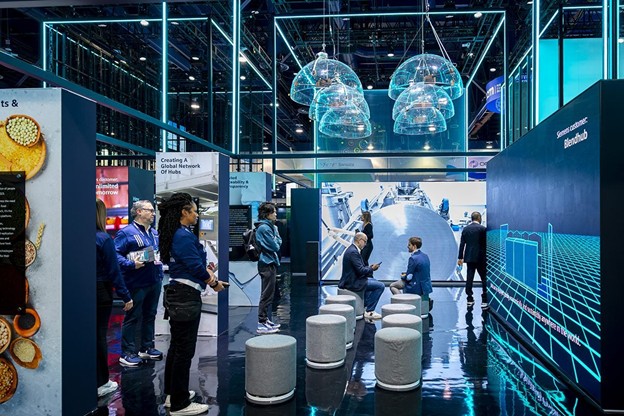

At CES, the biggest trade show in North America, normally a showcase for televisions, headphones and consumer gadgets, increasingly an AI show-and-tell, was swarming with humanoid robots. It seemed as if everyone had a humanoid robot in their booth. Let them be, Siemens seemed to say, we’re going to be about manufacturing and industry. In keynotes, sessions, press conferences, and in their booths and trailer (more on that later), they hammered home the point: Siemens is all about industrial robots and industrial AI, both of use to engineers and manufacturers.
The Booth
 No humanoid robots were to be seen at the Siemens booth. We were guided through the booth’s exhibits by Stacey Gromlich, who is in charge of Audience Engagement and Global Events for Siemens’ software division. She explained how Siemens used CES to establish brand recognition with an American audience and to unequivocally demonstrate its leadership in industrial AI.
This was not speculation. It was industrial AI already deployed—sometimes not perfectly—but definitely out there in the factory.
Industrial AI, Warts and All
One of the first demonstrations featured an industrial robot removing packages from a conveyor belt and autonomously stacking them. It was a small version of what Siemens is doing for PepsiCo’s packaging facilities. I was going smoothly, except for one case that was put down incorrectly or perhaps with too much force, denting the case.
It was not the only robot failure witnessed at CES this year—far from it. In fact, robot fails among humanoid robots, which were so numerous that they may well be the lingering and unintended theme of the show.
Siemens did not attempt to hide the fail. In fact, it became an inadvertent but effective proof point: industrial AI may not be perfect, but with data streaming from a digital twin of the production line, faults can be quickly diagnosed and corrected.
Digital Twins Reviving a Half-Century-Old Factory
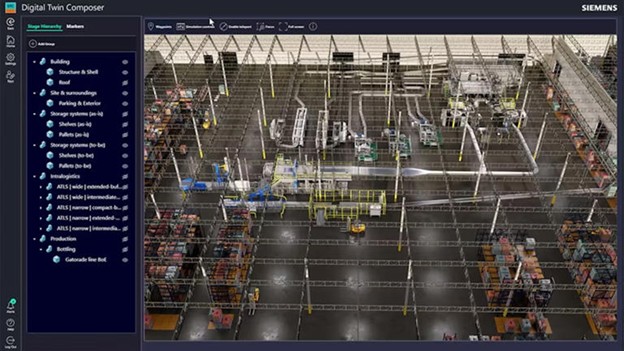
The most compelling customer story came from PepsiCo, where Siemens has helped retrofit and modernize packaging facilities that are roughly 50 years old.
Rather than scrapping legacy infrastructure, Siemens created full digital twins of entire plants, combining laser scans, operational data, and simulation models. This allows PepsiCo to:
- Reconfigure production lines virtually
- Identify bottlenecks before physical changes are made
- Test new product lines (seasonal SKUs, packaging variations) in months rather than years
- Use industrial AI to rapidly diagnose downtime events.
As Stacey noted, most manufacturers are not building “factories of the future” from scratch. They are, like PepsiCo, modernizing what they already have. Digital twins, composed of scans of existing infrastructure along with CAD models of new equipment, are the key to figuring it all out before the first piece of new equipment arrives on-site.
Fusion Energy and the Strong Magnets
PepsiCo is an all-American global brand, and an association with it may serve Siemens well in getting noticed by the typical consumer. But Siemens did not forget about industry and science. Here was Commonwealth Fusion Systems representing the very future of energy.
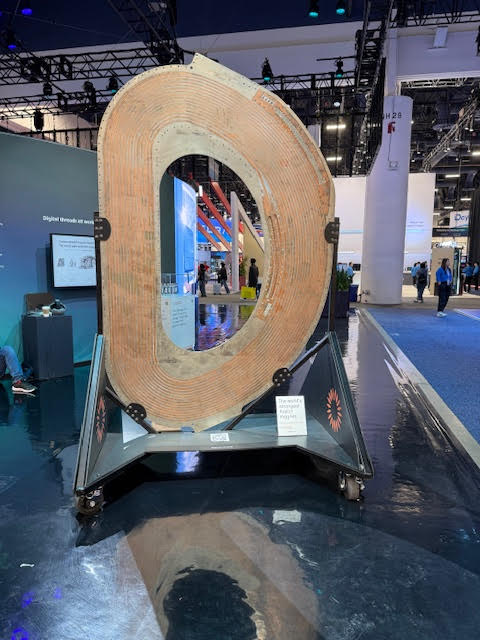
On display were the strongest magnets ever made, according to Siemens, capable of generating a magnetic field of 20 tesla (20 T). That’s an order of magnitude greater strength than the strongest magnetic field any of us is likely to encounter inside an MRI machine.
The promise is extraordinary: self-sustaining fusion energy, with a prototype expected to come online soon and commercial systems targeted for the early 2030s. Whether or not fusion timelines hold, Siemens’ role is clear—it supplies the digital backbone that allows such machines to be designed at all.
Microfactories, Fake Rocks, and Real Sustainability
Consumer products and fusion reactors may show Siemens’ business side, but who says the company cannot be fun? The most visually playful exhibit came from Haddy, a startup using Siemens technology to run portable microfactories that 3D-print large-scale structures, including artificial rock facades for Disney parks (replacing heavy, quarried stone). They also showed lightweight architectural elements and marine components with defense-grade safety requirements
The sustainability part of all this is that the polymer used by Haddy, not just in production parts but also in 3D printing rejects, can be melted down and reused
Xcelerator Goes On the Road
Inside the booth, all roads led back to Siemens Xcelerator, the company’s open digital business platform. Xcelerator is positioned as:
- A marketplace for software and solutions
- A data fabric connecting design, manufacturing, and operations
- An ecosystem integrating partners such as NVIDIA, AWS, Microsoft, Accenture, and Deloitte
The key message was openness: startups can enter at low cost, enterprises can scale globally, and customers are not locked into greenfield Siemens-only environments.
Though there might have been a hundred thousand attendees at CES, making it the biggest tradeshow in North America, even if all of them visited the Siemens booth, that would still be a tiny fraction of those who need to hear the message. For all those who, for whatever reason, can’t travel to hear about Xcelerator, Siemens intends to bring Xcelerator to them.
Next to the booth sat the Siemens Mobile Experience Center, a fully branded, double-wide trailer, which can be transported to and set up in a parking lot, staffed by Siemens employees eager to deliver the Xcelerator story to any manufacturing business in the US.
CES got perhaps the brief version because of the number of people lining up to go through it. The presentation inside was highly polished and tightly scripted—walks visitors through a pharmaceutical manufacturing scenario, emphasizing:
- Adaptive production
- AI-assisted troubleshooting
- Context-rich data over generic AI
- Measurable financial impact from reduced downtime
The Mobile Experience will go to manufacturers, customer sites, universities, events, and even Capitol Hill.
There might have been a hundred thousand attendees at CES, making it the biggest tradeshow in North America, but even at that size and with a huge presence, Siemens cannot reach everyone who needs to hear its message. To reach those who, for whatever reason, can’t travel to hear about Xcelerator, Siemens intends to bring Xcelerator
The 10–12 minute immersive experience focused on Smart Manufacturing and adaptive production, using a pharmaceutical manufacturing scenario as the anchor. The narrative frames modern manufacturing as under constant pressure from geopolitical shifts, supply chain volatility, labor shortages, and exploding data volumes—conditions that demand adaptation rather than just efficiency.
The tour demonstrates how Siemens connects fragmented operational data using comprehensive digital twins, software-defined automation, edge computing, and industrial AI copilots. A deliberately staged robot failure illustrates the core value proposition: contextualized data allows AI to diagnose faults in minutes rather than hours or days, dramatically reducing downtime and financial loss.
Strategically, the Mobile Experience Center is designed to:
- Meet manufacturers where they are (including those running Rockwell-heavy environments)
- Educate executives, engineers, and shop-floor workers in short, targeted sessions
- Serve as a branding and policy-engagement tool, visiting customer sites, universities, industry events, and even help lobby on Capitol Hill
Why Siemens Belongs at CES
CES was once a consumer electronics show. It is now a showcase of technology implementation. Siemens’ strategy is to ensure that when Americans think about AI, automation, or sustainability, they understand that Siemens is already embedded in the systems that deliver Doritos, power factories, and may one day power the grid itself.
As Stacey Gromlich explained, Europe already knows Siemens. The U.S. still needs to be reminded—not with slogans or slick advertising, but with proof.
At CES, Siemens did not just tell a story; it told a story. It demonstrate and AI-powered industrial future, where software runs hardware and digital twins ensure the success of their physical counterparts.
