

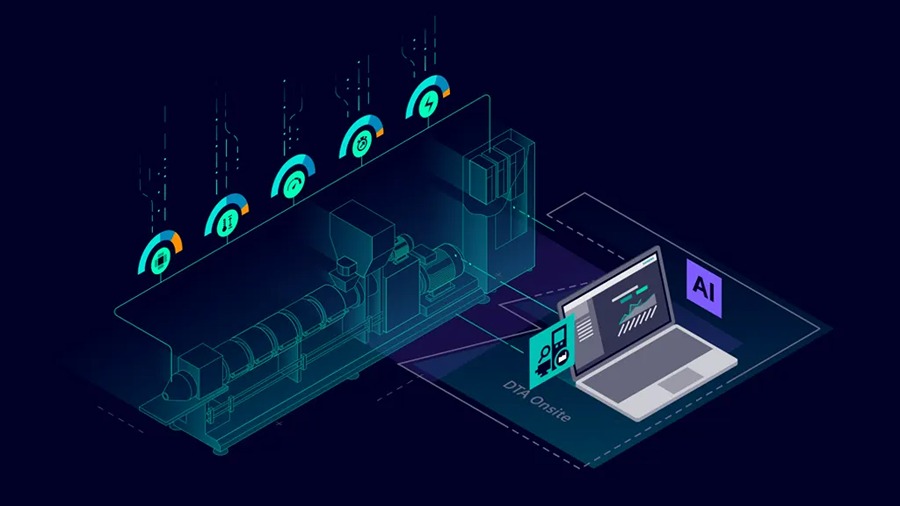
NUREMBERG, Germany, Mar 30, 2026 – Siemens has introduced Drivetrain Analyzer Onsite (DTA Onsite), an on-premises analytics solution for industrial drive systems. The software analyzes drive data within local infrastructure to meet data sovereignty requirements. The first module, DTA Onsite – Monitoring, delivers continuous condition monitoring of mechanical and electrical drivetrain components. It applies locally executed AI methods for pattern recognition and anomaly detection.
Monitoring as a New Module for Local Condition Monitoring
DTA Onsite – Monitoring collects high-resolution vibration and analog signals, including precision time protocol (PTP) synchronized data, via the Connection Modules Vibration (CM VIB), Fast Process Parameters (CM FPP), and IOT (CM IOT). It processes vibration data, analog values, and fingerprint information before analysis. The software presents plant overviews, KPI trends, and diagnostic dashboards through a web-based interface. Integrated AI identifies deviations in drivetrain behavior and indicates potential mechanical changes.
Drivetrain Analyzer Onsite Complements the Existing Cloud Offering
Siemens has added DTA-Onsite to its drivetrain analytics portfolio to support local data processing in industrial environments. The Drivetrain Analyzer Cloud, launched last year, supports cross-site and fleet-level analysis, while the onsite version targets use cases with strict data sovereignty, latency requirements or isolated networks. Both solutions follow a modular design but differ in deployment and integration models. Like Drivetrain Analyzer Cloud, DTA Onsite is part of Siemens Xcelerator.
DTA Onsite runs on industrial PCs using a containerized architecture and supports open interfaces such as MQTT, gRPC, and OPC UA. It integrates with SCADA systems, edge platforms, industrial PCs, and maintenance software. Data from sensors and automation systems is processed locally and presented through a unified monitoring interface.
DTA Onsite – Monitoring supports industrial systems with variable load, speed, and operating conditions. It applies to production equipment such as extruders, packaging machines, and textile systems, where detection of mechanical and process changes is required. The system also covers infrastructure assets including pump stations, compressors, and conveyor systems that operate continuously or under varying loads. In motion control applications, it tracks load peaks and changing operating states for detailed analysis. The approach reflects a shift toward local data processing in industrial analytics, where data control and response time remain critical.
Source: Siemens AG
About Siemens AG

Siemens AG is a technology company founded in 1847 and headquartered in Munich and Berlin, Germany. The company develops products and services in industrial automation, electrification, digital systems, and mobility. Its offerings include automation systems, industrial software, building technologies, rail transport systems, and power distribution solutions. Siemens also provides financial services and supports infrastructure projects. It serves industries such as manufacturing, energy, transportation, construction, and healthcare. The company works with enterprises, utilities, governments, and infrastructure operators worldwide. Siemens operates in more than 190 countries. It applies digital tools and AI to industrial and infrastructure use cases. Siemens holds a majority stake in Siemens Healthineers, a publicly listed healthcare technology company. Siemens has about 318,000 employees globally.
