

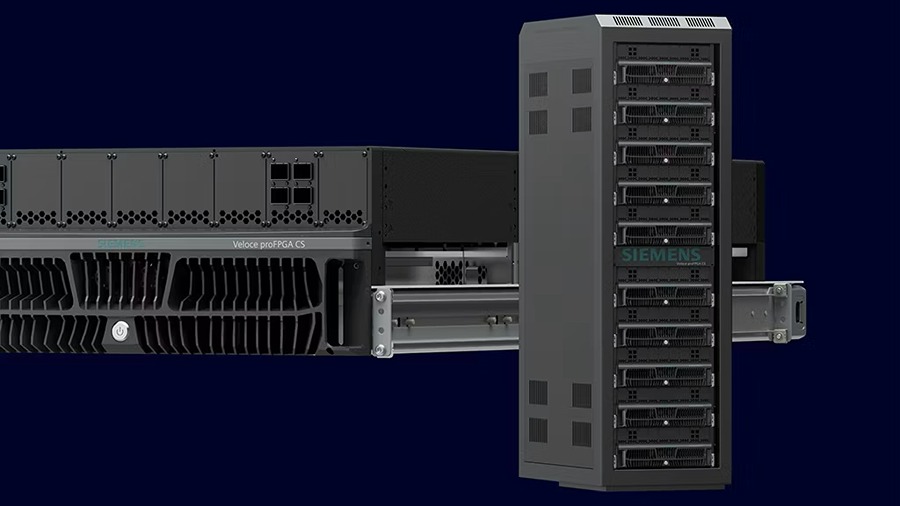
PLANO, TX, Apr 10, 2026 – Siemens is working with NVIDIA to run trillions of pre-silicon verification cycles using the Veloce proFPGA CS hardware-assisted verification and validation system. The system supports large-scale chip validation before first silicon availability.
The approach combines Siemens’ Veloce proFPGA CS hardware architecture with NVIDIA’s chip architecture to process tens of trillions of cycles within a few days. This setup uses FPGA-based prototype systems to run verification workloads faster than traditional simulation or emulation methods.
“NVIDIA and Siemens are partnering in many areas, most recently in advancing hardware-assisted verification methodologies in general and FPGA-based prototyping in particular, to adapt to the verification and validation demands presented by highly complex AI/ML SoCs,” said Jean-Marie Brunet, senior vice president and general manager, hardware assisted verification, Siemens Digital Industries Software. “Veloce proFPGA CS is addressing these challenges by combining a highly flexible and scalable hardware architecture with an advanced, easy-to use implementation and debug software flow, enabling customers to always have the optimal solution for single-FPGA IP validation as well as for multi-billion gate chiplet designs.”
“As AI and computing architectures grow increasingly complex, semiconductor teams require high-performance verification solutions to validate massive workloads and accelerate time to market,” said Narendra Konda, vice president of hardware engineering, NVIDIA. “The integration of NVIDIA performance-optimized chip architectures with Siemens’ Veloce proFPGA CS enables designers to capture trillions of cycles in days, providing the scale needed to ensure reliability for the next generation of AI.”
Field-programmable gate array (FPGA) based prototyping allows engineers to execute pre-silicon workloads at higher speeds, reducing verification time compared with simulation-based tools. As AI/ML chip designs increase in complexity, both hardware and software requirements continue to drive demand for higher verification throughput.
Traditional verification methods, including simulation and emulation, handle millions to a few billion cycles within practical time limits. Running trillions of cycles in a short time frame is required to meet current design complexity, development timelines, and reliability requirements.
Source: Siemens
About Siemens Digital Industries Software

Siemens Digital Industries Software, a business unit of Siemens AG, provides industrial software, hardware and related services through the Siemens Xcelerator platform. The company’s portfolio includes product lifecycle management, electronic design automation, simulation and digital twin tools, manufacturing operations management and low-code application development. These products support design, engineering and production workflows across sectors such as aerospace and defense, automotive, electronics and semiconductors, machinery, medical devices and process manufacturing. Siemens Digital Industries Software traces its origins to 1963 as United Computing, later becoming Siemens PLM Software in 2007 before adopting its current name. It supplies technologies that help organizations manage product, process data, and improve development and manufacturing efficiency across a range of industrial applications.
About Siemens Digital Industries
Siemens Digital Industries (DI), a division of Siemens AG, focuses on industrial automation and digitalization. Based in Nuremberg, Germany, the division provides software, automation systems, and digital services that support the full product and production lifecycle—from design and engineering to manufacturing and maintenance. With a history extending over six decades, Siemens DI serves key sectors including automotive, aerospace, pharmaceuticals, energy, and electronics. Its technologies, such as the Xcelerator platform and SIMATIC automation systems, are designed to integrate physical and digital processes, enabling data-driven manufacturing and operational efficiency. The division reports annual revenues exceeding €18 billion and employs approximately 70,000 people globally. Its portfolio supports manufacturers in implementing Industry 4.0 strategies by linking simulation, automation, and real-time data in scalable systems.
About Siemens AG
Siemens AG is a technology company founded in 1847 and headquartered in Munich and Berlin, Germany. The company develops products and services in industrial automation, electrification, digital systems, and mobility. Its offerings include automation systems, industrial software, building technologies, rail transport systems, and power distribution solutions. Siemens also provides financial services and supports infrastructure projects. It serves industries such as manufacturing, energy, transportation, construction, and healthcare. The company works with enterprises, utilities, governments, and infrastructure operators worldwide. Siemens operates in more than 190 countries. It applies digital tools and AI to industrial and infrastructure use cases. Siemens holds a majority stake in Siemens Healthineers, a publicly listed healthcare technology company. Siemens has about 318,000 employees globally.
About NVIDIA

NVIDIA, founded in 1993 and headquartered in Santa Clara, CA, designs and manufactures graphics processing units, systems on chips, networking hardware, and AI intelligence software such as CUDA. Its products serve industries including gaming, data centers, autonomous vehicles, professional visualization, robotics, health care, and energy. The company introduced the GPU in 1999 and later expanded into accelerated computing and AI infrastructure. In gaming, its GPUs support high-performance rendering, while in AI and high-performance computing, its systems provide the infrastructure for training and deploying large-scale models. NVIDIA also develops tools for robotics and autonomous driving.
