

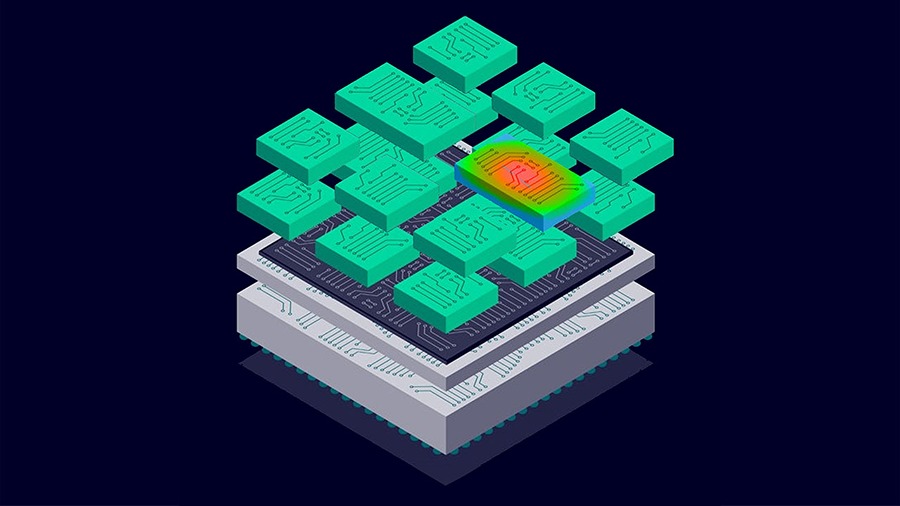
SAN FRANCISCO, CA, June 26, 2025 – Siemens Digital Industries Software has introduced two new solutions to its Electronic Design Automation (EDA) portfolio to help semiconductor design teams manage the complexity of 2.5D and 3D Integrated Circuit (IC) design and manufacturing.
Innovator3D IC solution suite enables IC designers to author, simulate and manage heterogeneously integrated 2.5D/3D IC designs. In addition, Siemens’ Calibre 3DStress software leverages thermo-mechanical analysis to identify the electrical impact of stress at the transistor level. Together, these solutions reduce risk and enhance the design, yield and reliability of 2.5D/3D IC designs.
“By delivering a stress-aware multiphysics analysis solution powered by Calibre 3DStress and driven by the Innovator3D IC solution suite, Siemens enables customers to overcome the complexities and risks associated with 3D IC designs,” said Mike Ellow, CEO, Siemens EDA, Siemens Digital Industries Software. “These capabilities are critical for our customers, allowing them to accelerate productivity and meet stringent design timelines by effectively eliminating the barriers of design complexity that traditionally impact design cycles.”
Innovator3D IC solution suite
Siemens’ Innovator3D IC solution helps semiconductor teams handle design planning, integrate multiple chip components, develop substrates and interposers, verify interface protocol compliance, and manage design data IP.
Built with AI-based tools and multithreading capabilities to handle designs with over 5 million pins, the Innovator3D IC solution includes four main components: the Innovator3D IC Integrator, providing a workspace for constructing digital twin using a data model to support design planning, prototyping, and analysis; the Innovator3D IC Layout solution, which supports package interposer, and substrate design; the Innovator3D IC Protocol Analyzer, which checks compliance for chiplet-to-chiplet and die-to-die interfaces; and the Innovator3D IC Data Management tool, which manages design data and in-progress work.
Calibre 3DStress
With thinner dies and higher packaging temperatures in 2.5D and 3D IC architectures, designers often find that circuits verified at the die level may not meet specifications after packaging reflow processes.
Calibre 3DStress helps solve thermo-mechanical stress and warpage issues in 3D IC packaging. It offers transistor-level analysis, verification, and debugging to evaluate how chip-package interactions affect design function. This helps designers find issues early in development stage and make changes to improve durability.
Building on the launch of Calibre 3DThermal in 2024, Calibre 3DStress expands the multiphysics solution, reducing thermo-mechanical impacts, and delivering design and electrical behavior visibility earlier in the design process. Calibre 3DStress detects transistor level stress to verify that neither packaging processes nor product functionalities will compromise circuit level performance.
Calibre 3DStress is part of Siemens’ 3D IC multi-physics software portfolio and contributes to its IC digital twin workflows. It integrates Calibre physical verification with a mechanical solver to analyze stresses in IC structures and materials.
Customer experiences with Siemens’ technologies for 3D IC design
“In 2023, we adopted Siemens’ technology to meet the complex design and integration challenges of our advanced platform solutions. The Innovator3D IC solution suite plays a critical role in enabling the high-performance solutions we deliver to AI and HPC datacenters,” said Bryan Black, CEO of Chipletz, a fabless AI platform provider.
“Siemens EDA’s Calibre 3DStress tool can synthesize the complexity of components, materials and processes related to 3D IC architectures and can create accurate IP-level stress analysis. Using it, ST has been able to implement early design planning and sign-off flows, and accurately model potential electrical failures due to IP-level stress within a 3D IC package. The result is improved reliability and quality, together with a reduced time to market, which provide a win both for ST and our customers,” said Sandro Dalle Feste, APMS central R&D senior director, STMicroelectronics.
Source: Siemens
Siemens Digital Industries Software

Siemens Digital Industries Software delivers integrated tools and services to support digital transformation across engineering and manufacturing workflows. Its offerings help companies streamline product design, optimize manufacturing, and manage operational data more effectively. The company serves sectors such as automotive, aerospace, industrial equipment, electronics, and consumer goods. Its work in areas like product lifecycle management (PLM) and manufacturing systems plays a key role in advancing digital continuity and efficiency. Headquartered in Plano, TX, it operates as a business unit of Siemens AG.
Siemens Digital Industries (DI)

Siemens Digital Industries (DI), a division of Siemens AG, focuses on industrial automation and digitalization. Based in Nuremberg, Germany, the division provides software, automation systems, and digital services that support the full product and production lifecycle—from design and engineering to manufacturing and maintenance. With a history extending over six decades, Siemens DI serves key sectors including automotive, aerospace, pharmaceuticals, energy, and electronics. Its technologies, such as the Xcelerator platform and SIMATIC automation systems, are designed to integrate physical and digital processes, enabling data-driven manufacturing and operational efficiency. The division reports annual revenues exceeding €18 billion and employs approximately 70,000 people globally. Its portfolio supports manufacturers in implementing Industry 4.0 strategies by linking simulation, automation, and real-time data in scalable systems.
Siemens AG

Siemens AG, headquartered in Munich, Germany, is a technology company operating in the industry, infrastructure, transportation, and healthcare sectors. Founded in 1847, Siemens provides a range of products and services, including industrial automation systems, digitalization solutions, energy-efficient technologies, and medical diagnostic equipment. In fiscal year 2024, which ended on September 30, Siemens reported revenue of €75.9 billion and a net income of €9.0 billion. The company employs approx. 312,000 people globally, with around 90,000 based in Germany. Siemens is one of Europe’s largest industrial manufacturers and holds a noteworthy position in global markets for automation, industrial software, and digital solutions. The company also owns a majority stake in Siemens Healthineers. Siemens applies technologies such as industrial AI and generative AI to improve efficiency, operational performance, and sustainability across manufacturing, infrastructure, and mobility sectors.
