

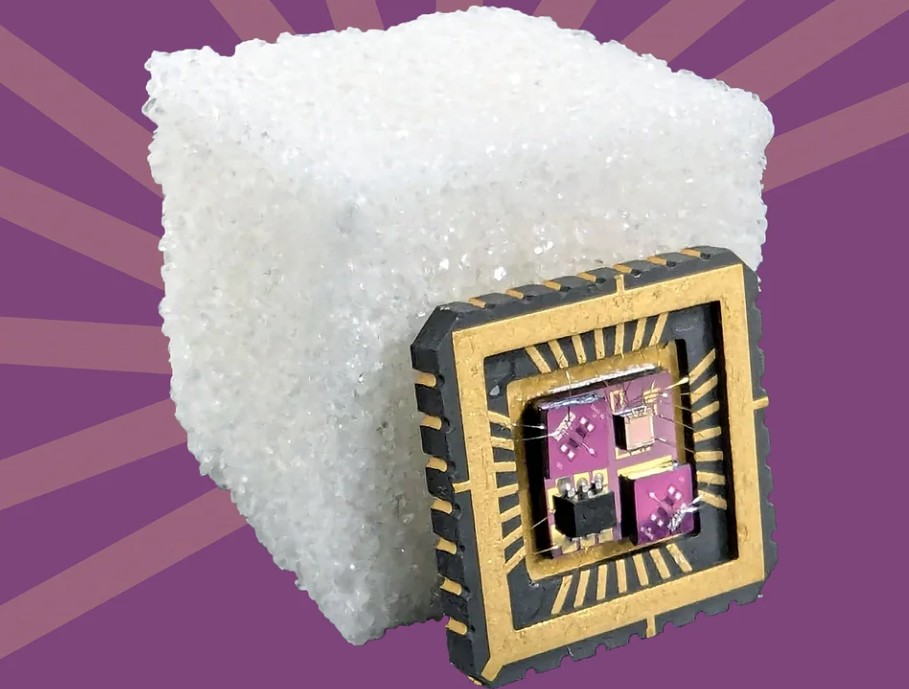
Researchers at the University of Michigan have built a tiny timekeeping device that approaches the stability of atomic clocks while fitting on a chip smaller than a sugar cube, tells IEEE Spectrum. The device uses microelectromechanical systems (MEMS) with a doped silicon resonator and integrated heater to maintain a stable frequency, deviating only about 102 nanoseconds over eight hours. That performance nears that of much larger atomic clocks, which define the standard for precision timing but require bulky hardware and high power.
Atomic clocks work by measuring the oscillations of atoms, such as cesium or rubidium, to mark a second with extreme precision. Traditional designs are the size of cabinets and consume tens of watts, making them impractical for many applications outside labs or GPS satellites. Even commercial chip-scale atomic clocks are roughly 10–100 times larger than this new MEMS clock and use more energy.
The core of the MEMS clock is a silicon plate with a piezoelectric film that vibrates at a stable frequency, monitored by nearby electronics. A built-in heater helps maintain a constant temperature to reduce drift from environmental changes. By doping the silicon, researchers tuned its mechanical properties to resist temperature-induced changes, stabilizing the resonator itself. That design choice and integrated thermal control let the device maintain its timekeeping with minimal external support.
Smaller, low-power clocks like this matter because modern systems, from satellite navigation to communications networks and distributed electronics, depend on precise timing. Many technologies today rely on GPS for synchronization, but in environments where GPS isn’t available, internal clocks must fill in. A compact MEMS clock could offer accurate, power-efficient timing in space missions, underwater systems, or future distributed computing architectures.
The team presented this work at the 71st IEEE International Electron Devices Meeting, and while there’s still work to refine long-term stability, the results point toward a new class of integrated timekeepers that bridge the gap between quartz oscillators and atomic clocks.
