

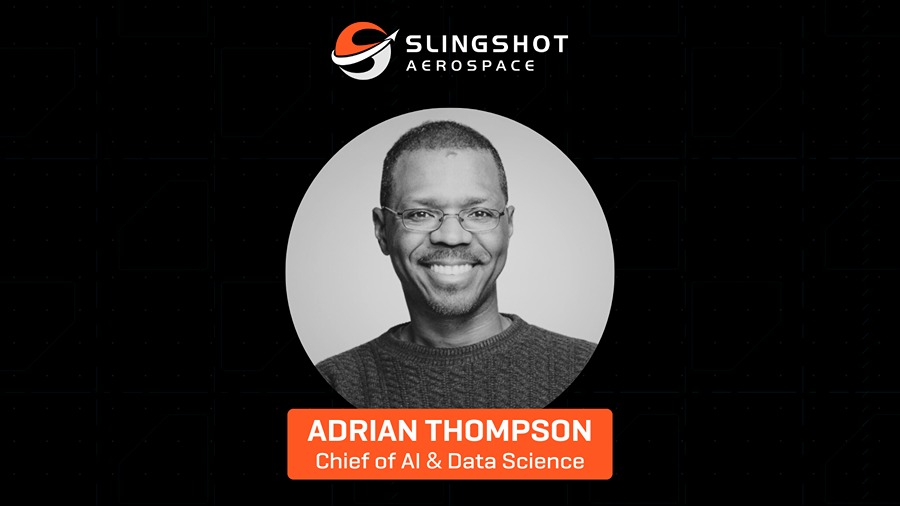
Slingshot Aerospace appointed Adrian Thompson as chief of artificial intelligence (AI) and data science, where he will lead the company in AI and engineering.
Thompson is an engineering and technology leader with more than 26 years of experience developing safety-critical systems for autonomous vehicles, aerospace, industrial automation and building systems. He has held senior roles at TuSimple, Waymo, Uber ATG, L3 Technologies, GE Aviation and United Technologies Research Center, where he led global engineering teams working in domains like autonomy, intelligent systems, sensing, verification and validation, and testing.
Thompson has experience overhauling engineering processes, aligning AI and systems development with business strategy, and deploying mission-critical capabilities across global teams.
“Adrian brings the rare combination of deep technical expertise and operational discipline needed to build AI systems that must perform flawlessly in high-stakes environments,” said Tim Solms, chief executive officer of Slingshot Aerospace. “His leadership will accelerate our work to deliver next-generation AI for space domain awareness and operational decision-making.”
Thompson holds a Ph.D. in Control Engineering from the University of Toronto, an MBA from the University of Chicago Booth School of Business, and a B.A.Sc. in Chemical Process Engineering from the University of the West Indies.
Source: Slingshot Aerospace
About Slingshot Aerospace

Founded in 2017, Slingshot Aerospace delivers space simulation and analytics solutions to enhance situational awareness in complex environments. Its platform combines data from satellites, drones, aircraft, and ground sensors, applying AI and machine learning to support space object tracking, traffic coordination, and simulation. The system integrates inputs from Slingshot’s Global Sensor Network, the Seradata database, satellite operators, and other sources to create a unified view of space activity – past, present, and projected – used for planning, training, and operations. Slingshot serves both government and commercial clients, including NASA and the U.S. Space Force, aiming to reduce risk and improve safety in space operations. As of 2024, the company has about 137 employees and maintains offices in Colorado and the UK. It secured $30M in funding in September 2024. Slingshot aims to ensure safe, sustainable space operations using modeling, astrodynamics, and data fusion.
