

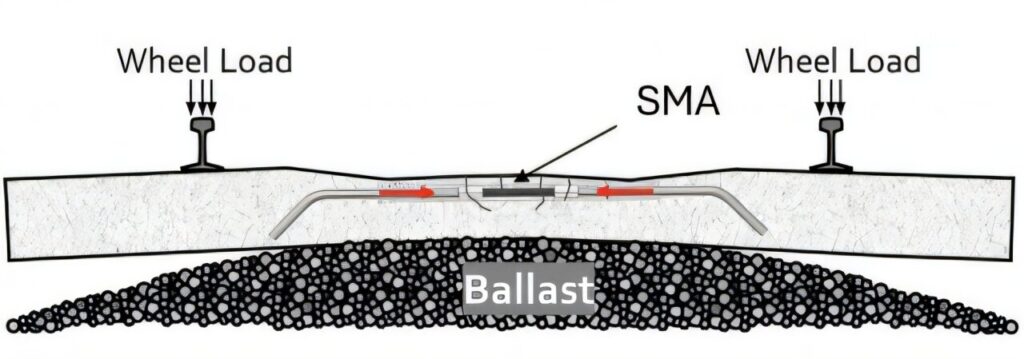
Railroad tracks rely on concrete crossties (or sleepers) to maintain gauge and stability, yet repeated traffic and ballast settlement cause these ties to warp, crack, or deform, thereby risking performance and safety. Engineers at the University of Illinois Urbana-Champaign, led by professor Bassem Andrawes, have developed a reinforcing strategy using shape-memory alloys (SMAs) embedded within the ties, tells Tech Xplore.
SMAs are metals engineered to “remember” an original shape. After being deformed under load, when triggered (in this case via induction heating), they revert toward that original shape, essentially self-correcting warped concrete. The team cast commercially available concrete ties with SMA inserts, then subjected them to simulated rail-traffic loads. They found that the SMAs could compensate for distortion and restore compliance with industry standards (via the American Railway Engineering and Maintenance-of-Way Association standard).
Unlike conventional prestressing rods, which apply static force, these SMAs can be locally activated and adjusted to respond to varying stresses throughout the tie’s structure. Induction heating means there’s no embedded wiring inside the tie itself, just an external electromagnetic field. The industrial partner is Rocla Concrete Tie, Inc., and the next steps include full-scale field tests with the Federal Railroad Administration near Pueblo, Colorado.
For engineers designing rail infrastructure, this is significant: embedding intelligent materials offers a new maintenance paradigm, ties that self-recover rather than needing replacement or frequent intervention. Challenges remain: cost, lifecycle behavior of SMAs in harsh track environments, and integration with existing monitoring systems. Still, this research signals that “smart materials” are moving from labs into heavy-duty rail applications.
