

Researchers at KAIST have tackled a longstanding weakness of photocurable 3D printing, its fragility, by combining novel materials with AI-driven design and light modulation. The result is a process that not only improves mechanical strength but also cuts costs and complexity, tells Tech Xplore.
Photocurable 3D printing (often through digital light processing, DLP) is valued for precision and flexibility. But printed parts usually break under shock or vibration, limiting use in demanding applications. Traditional methods, such as injection molding, produce tougher parts but incur high tooling costs. The KAIST team’s breakthrough bridges that gap.
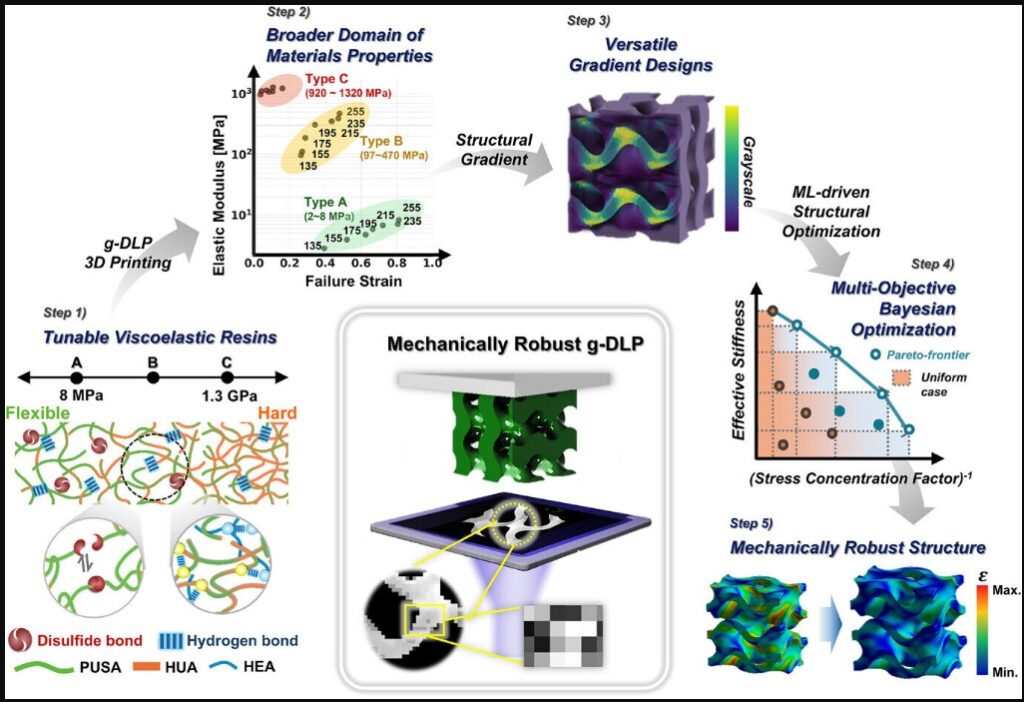
Their approach rests on two innovations. First, a new resin: a polyurethane acrylate (PUA) with dynamic bonds that absorb shock and distribute stress. Second, “grayscale DLP” light modulation: by varying light intensity during curing, parts of a single print can have different mechanical strengths. To orchestrate this, an AI model recommends where to stiffen or soften the structure based on predicted loads and usage.
This synergy of material, optical control, and AI means you get gradient-strength structures without needing multiple materials or switching print heads. That simplifies production and cuts costs. The design cycle also speeds up: AI automates strength assignments, reducing manual iteration.
Because durability and cost-efficiency both improve, this method has wide potential. The team points to applications in medical implants, aerospace parts, robots, and precision machinery, sectors where strength and customization both matter.
By treating strength as a spatial variable and letting light + AI do the tailoring, the researchers turn one of 3D printing’s greatest liabilities into an advantage. This could reshape how we build complex, high-performance parts using additive methods.
