

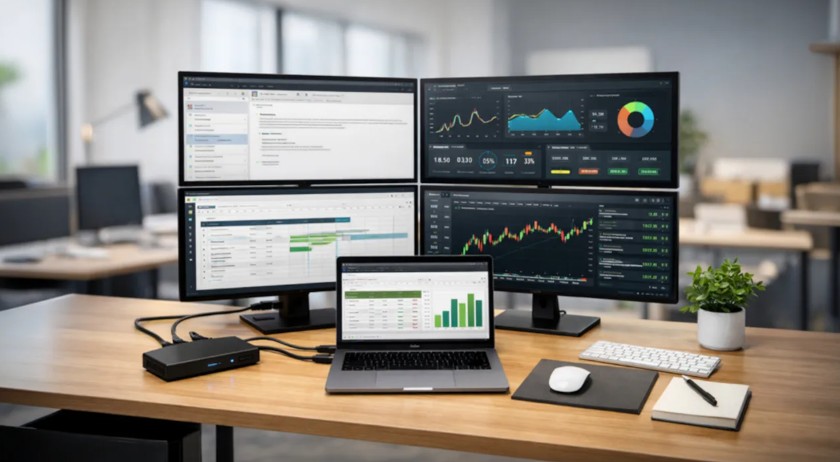
Display interfaces are evolving to meet a new reality: users now work across multiple devices, operating systems, and screens, creating a need for more flexible and scalable connectivity. The article from Design News highlights how modern solutions, particularly Synaptics’ DisplayLink technology, are redefining how displays connect and communicate.
Traditional display connections rely on fixed standards such as HDMI or DisplayPort, which can limit compatibility and scalability. DisplayLink takes a different approach by treating display output as compressed data that can be transmitted over various interfaces. This “transport-agnostic” model allows a single system to support multiple displays across different devices without being tied to specific hardware constraints.
At the core of this architecture is intelligent compression, which optimizes bandwidth while maintaining image quality. Instead of relying solely on GPU-driven output, DisplayLink distributes processing across the host system and dedicated chips. Advances in encoding, latency reduction, and color fidelity have made it possible to drive high-resolution displays, such as 4K at 60 Hz, with only modest CPU overhead.
Another key advantage is integration. Because display data is packetized, additional functions such as USB, audio, Ethernet, and firmware updates can be bundled into a single docking solution. This simplifies hardware design and enables universal docking stations that work across diverse devices, from laptops to mobile platforms.
The technology also reflects broader shifts in computing. Modern workplaces increasingly rely on hybrid setups, combining thin laptops, ARM devices, and legacy systems. DisplayLink reduces variability across these environments, allowing organizations to expand display capabilities incrementally without replacing entire systems.
Looking ahead, new developments such as AI-enabled docking stations and multi-display scaling, including support for up to four displays, point to further innovation. These systems can enable smarter troubleshooting, device management, and edge processing capabilities.
The article ultimately positions display interfaces as more than simple connectors. By combining compression, adaptability, and integrated functionality, next-generation solutions are transforming displays into flexible, software-defined systems that can evolve alongside changing hardware and user needs.
