

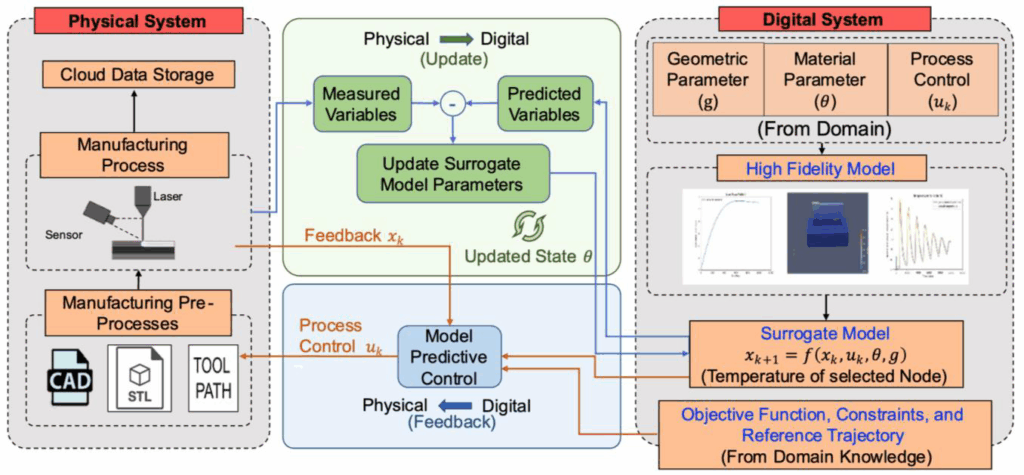
Northwestern University and Case Western Reserve University scientists have developed a comprehensive digital twin framework tailored for laser Directed Energy Deposition (DED) processes, tells 3D Printing Industry. Their system marries a Bayesian Long Short-Term Memory (LSTM) model for thermal prediction with a Bayesian optimization method to fine-tune process parameters. The result is one of the most advanced demonstrations of a bidirectional, adaptive digital twin for metal additive manufacturing to date.
In typical DED, a laser melts metal powder or wire onto a substrate, building parts layer by layer. But temperature swings and thermal stresses often cause microstructural inconsistencies and defects. Traditional control techniques (like PID feedback) help somewhat but have limited predictive capability and can’t fully adapt to unforeseen disturbances. The new framework continually exchanges information between the real machine and its virtual model: it updates predictions based on sensors, then feeds optimized parameters back to adjust the process.
At its core is a surrogate Bayesian LSTM model that predicts temperature profiles across the part, replacing slower physics simulations. The model also quantifies uncertainty using techniques like Monte Carlo dropout and variational Bayesian inference, which helps the system make decisions under ambiguity. The team validated it using data from experiments with Inconel 718 builds, achieving an R² of 0.75 on test datasets. Predictions are most precise near active melt zones, with greater uncertainty at deeper or lagging regions.
Complementing the predictive model is Bayesian Optimization for Time Series Process Optimization (BOTSPO), a technique to optimize laser power profiles over time. It compresses the high-dimensional control problem into a manageable parameter set (via a modified Fourier representation), allowing efficient exploration and refinement of laser waveforms. In simulated thin-wall tests, BOTSPO increased the duration spent in desired thermal zones by ~26%.
Putting both components together, the digital twin system offers a feedback loop: the optimization defines a target trajectory, while real-time predictions adapt in response to actual behavior. This kind of closed-loop, physics-aware, uncertainty-aware control is a major step toward autonomous metal 3D printing. The researchers plan next to integrate their system with a real DED machine and improve the twin’s ability to correct itself over longer builds.
