

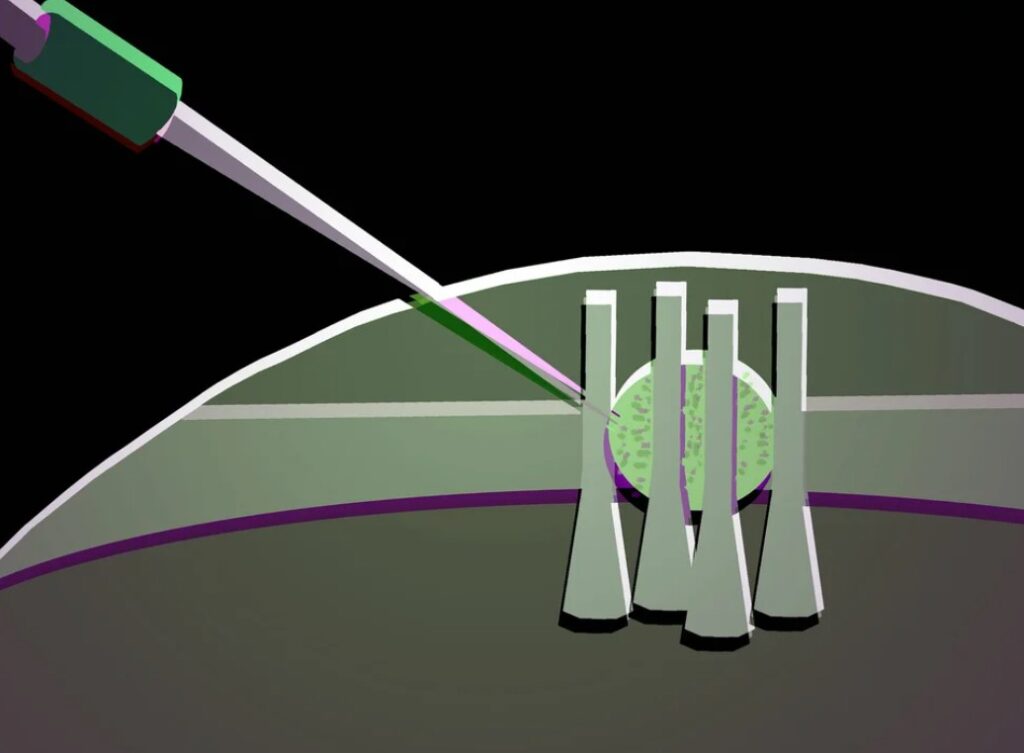
A new direction in photonics is emerging from an unexpected place: soft, flexible materials. Instead of relying on rigid silicon structures, researchers are developing photonic devices built from polymers and liquid crystals that can manipulate light using light itself. This approach, often called soft photonics, could open a path toward faster and more energy-efficient computing systems, tells IEEE Spectrum.
Traditional photonic systems already promise major advantages over electronics, including higher speeds and lower energy consumption. However, most existing devices depend on hard materials and electrical control, limiting their flexibility and manufacturing simplicity. Soft photonics challenges are modeled by using materials that are easier to shape, cheaper to produce, and compatible with new device geometries.
At the center of this innovation is a liquid-crystal-based photonic switch. The device consists of a microscopic droplet of liquid crystal infused with fluorescent dye and held in place by a soft polymer structure. When a laser pulse enters the system, light circulates within the droplet in a resonant loop. A second laser pulse can then suppress or amplify the first, effectively controlling whether light exits the device. This interaction demonstrates a key capability: controlling light purely with light, without electrical input.
This method offers a significant energy advantage. Earlier soft-matter photonic approaches required intense light to alter material properties, but the new technique operates at much lower energy levels, reducing power consumption by more than a hundredfold. It also enables faster switching speeds, since the process occurs on extremely short timescales.
Beyond efficiency, soft photonics expands design flexibility. Liquid crystals allow researchers to experiment with a wide range of shapes and optical cavities, while fabrication can occur quickly and at low temperatures. These characteristics make the technology attractive for scalable manufacturing and novel device architectures.
Although still in early stages, the concept points toward photonic logic circuits and even optical neural networks. Researchers caution that it will take time to compete with existing computing systems, but the potential is clear. By combining soft materials with light-based control, soft photonics introduces a fundamentally different way to process information, one that could reshape computing at its core.
