

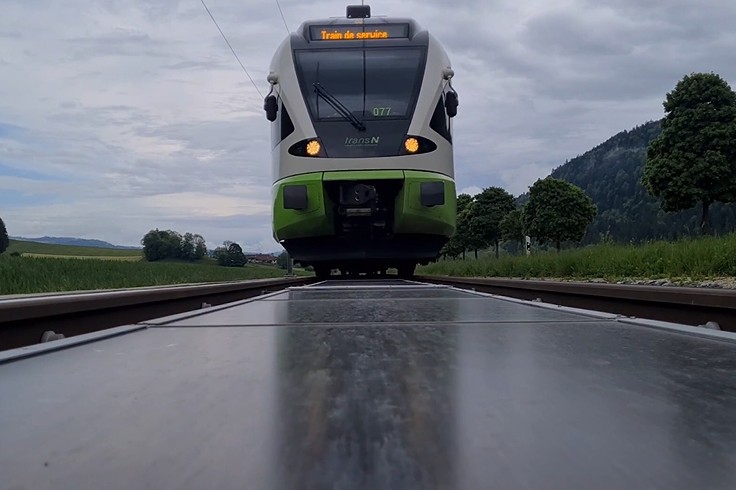
Switzerland’s extensive railway network could become a new source of renewable electricity. Swiss startup Sun-Ways and public transit operator TransN are testing solar panels installed between active railway tracks, potentially turning land already devoted to transportation into clean-energy infrastructure, tells The New York Times.
The pilot began last April in Buttes, Switzerland, on a section of track about the length of a football field. Sun-Ways secures photovoltaic panels between the rails with pistons pressing against the steel tracks. A key advantage is accessibility. A single worker can remove the panels in about 10 minutes when crews need to perform track maintenance.
Sun-Ways estimates that deploying its technology across Switzerland’s rail network could supply up to 30% of the country’s public transportation energy needs. The concept is also attracting international interest. France’s national railway company, SNCF, partnered with Sun-Ways in February to evaluate the technology and is testing multiple solar designs. South Korea approved a two-year pilot, while an Italian project is expected to begin testing within the next year.
Railway solar could address one of renewable energy’s persistent challenges: land availability. Conventional ground-mounted solar installations can require about two and a half acres to produce one megawatt. Railway corridors provide existing infrastructure where panels can be deployed without acquiring large areas of additional land. An Italian engineer estimates that equipping 20% of Italy’s railways could provide one gigawatt of generating capacity, potentially enough to power up to one million homes.
Challenges remain before large-scale deployment becomes practical. Researchers are studying electrical architectures that could reduce energy losses when excess electricity is transmitted elsewhere or supplied to the grid. Cost is another unresolved issue, although existing railway land could reduce expenses.
The Buttes pilot will continue through 2028. Its technical and economic results could help determine whether solar-equipped railways can become a practical part of Europe’s expanding renewable-energy infrastructure.
