

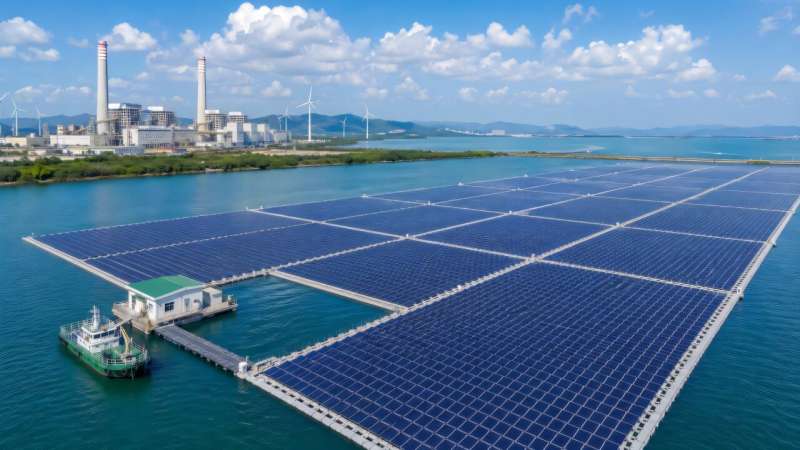
Floating solar power systems are emerging as a promising alternative to traditional land-based solar farms, particularly in regions where available land is limited. A recent study highlighted by Tech Xplore found that offshore floating photovoltaic systems can generate significantly more electricity over their operational lifetime than comparable land-based installations.
The research was conducted by scientists at National Taipei University of Technology in Taiwan, where geographic constraints and high population density make large-scale renewable energy expansion difficult. The team compared a conventional land-based photovoltaic installation at Changbin Industrial Park with Taiwan’s first large-scale commercial offshore floating photovoltaic system. To ensure a fair comparison, both systems were normalized to the same 100-megawatt-peak scale using a lifecycle energy assessment approach.
According to lead researcher Ching-Feng Chen, the offshore floating system produced approximately 12% more electricity over its lifetime than the land-based equivalent. The higher energy yield also translated into greater reductions in carbon emissions. One major reason for the improved performance is the cooling effect of surrounding water. Solar panels become less efficient when temperatures rise, but offshore environments help absorb excess heat and maintain more stable operating conditions.
The article notes that offshore floating photovoltaic systems are attracting growing attention worldwide as nations seek additional pathways toward net-zero carbon goals. Unlike ground-mounted solar farms, floating systems avoid competition for agricultural or urban land while potentially expanding renewable energy generation into coastal and marine areas.
At the same time, the technology still faces engineering and economic challenges. Offshore installations must withstand harsh marine environments, including corrosion, strong waves, and difficult maintenance conditions. Infrastructure costs also remain higher than those of many conventional solar projects.
Despite these hurdles, the study suggests that floating solar systems could become an increasingly important component of future renewable-energy strategies. As countries confront land shortages and rising electricity demand, offshore solar may offer a practical way to expand clean-energy generation beyond the limits of terrestrial infrastructure.
