

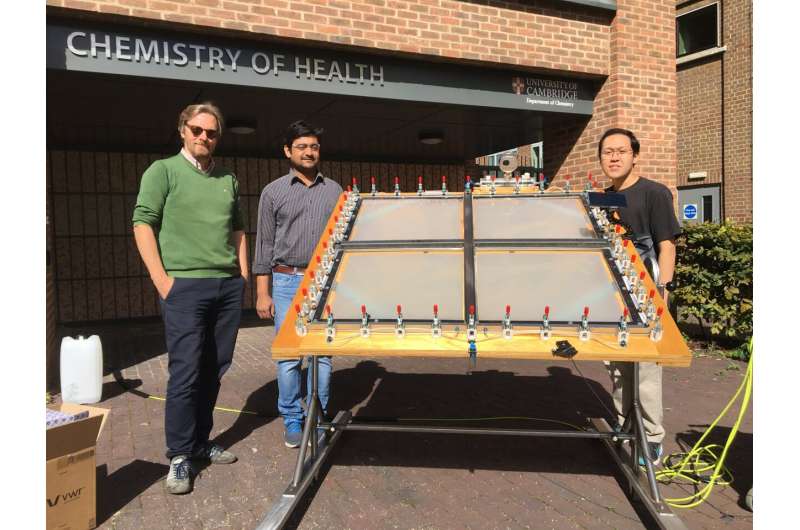
Researchers at the University of Cambridge have taken a significant step toward commercializing solar-powered plastic recycling by successfully demonstrating a reactor that converts plastic waste into clean hydrogen fuel under real-world outdoor conditions. The technology, previously proven only in laboratory experiments, has now been scaled up to a one-square-meter reactor that operates using natural sunlight, marking an important milestone in sustainable waste management and renewable energy production, tells Tech Xplore.
Unlike conventional solar panels that generate electricity, the reactor uses sunlight to drive a chemical reaction known as photoreforming. The process converts discarded plastics, including polyethylene terephthalate (PET) drink bottles, into hydrogen fuel and valuable industrial chemicals while simultaneously splitting water. The system offers a dual environmental benefit by reducing plastic waste and producing clean energy without relying on fossil fuels. The research was published in Nature Chemical Engineering.
Scaling the technology presented major engineering challenges. Earlier laboratory systems relied on small photocatalyst panels roughly 25 centimeters square, and manufacturing techniques that were impractical for large-scale production. To overcome these limitations, the researchers developed a scalable fabrication process for the photocatalyst films, eliminating the need for large chemical baths and simplifying manufacturing. The successful outdoor trial demonstrates that the technology can maintain its performance under natural environmental conditions, an essential requirement for commercial deployment.
The project addresses two pressing global challenges: plastic pollution and the transition to low carbon energy. By transforming waste into useful products using only sunlight, the reactor supports circular economy principles while providing a potential source of green hydrogen for industrial and energy applications. The researchers believe the scalable manufacturing approach is as important as the chemical process itself because it provides a realistic pathway toward industrial adoption.
Although additional work is needed before commercial deployment, the successful scale-up demonstrates that solar-driven plastic recycling can move beyond laboratory experiments. The research suggests that future facilities could simultaneously reduce plastic waste, recover valuable materials, and generate clean hydrogen, offering a practical and sustainable alternative to conventional recycling and waste disposal methods.
