

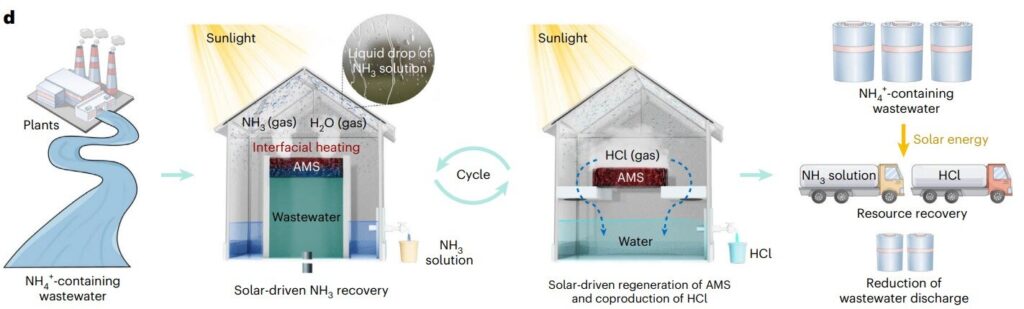
Researchers have developed a floatable, amino-grafted MXene (Ti₃C₂)-based sponge (AMS) that uses sunlight to recover high-purity ammonia (NH₃) from wastewater—offering both purification and fertilizer production in one sustainable system, says Tech Xplore.
How it works:
- The sponge floats on the wastewater surface and, when illuminated, uses interfacial solar heating and embedded –NH₂ groups to locally shift equilibrium from ammonium (NH₄⁺) to ammonia by binding H⁺ ions—no added chemicals or heating needed.
- The MXene material (Ti₃C₂) absorbs solar energy efficiently, heating the interface to drive ammonia evaporation, which is then collected via condensation.
Performance metrics:
- Recovery rate: ~ 0.6 mol/m²/h using ammonium chloride wastewater under 5-sun light intensity.
- Purity: ~ 99.8% ammonia.
- Self-regeneration: sponge reactivates under 15-sun intensity and also yields hydrochloric acid as a by-product.
Environmental and economic advantages:
- Emits just 0.102 ton CO₂‐equivalent per ton of ammonia recovered—30× lower emissions than the traditional Haber–Bosch process.
- Reduces reliance on fossil-fuel-intensive industrial ammonia production, offering sustainable fertilizer directly from wastewater streams.
Future outlook
The study (published in Nature Sustainability) points to the need for further optimization of the sponge design tailored to diverse wastewater types, seasonal conditions, and specific industrial contexts. These adaptations could enhance scalability and real-world applicability.
This innovative, solar-driven sponge offers a low-carbon, cost-effective route to treat nitrogen-rich wastewater while simultaneously generating a valuable nitrogen fertilizer—supporting both environmental and agricultural sustainability.
