

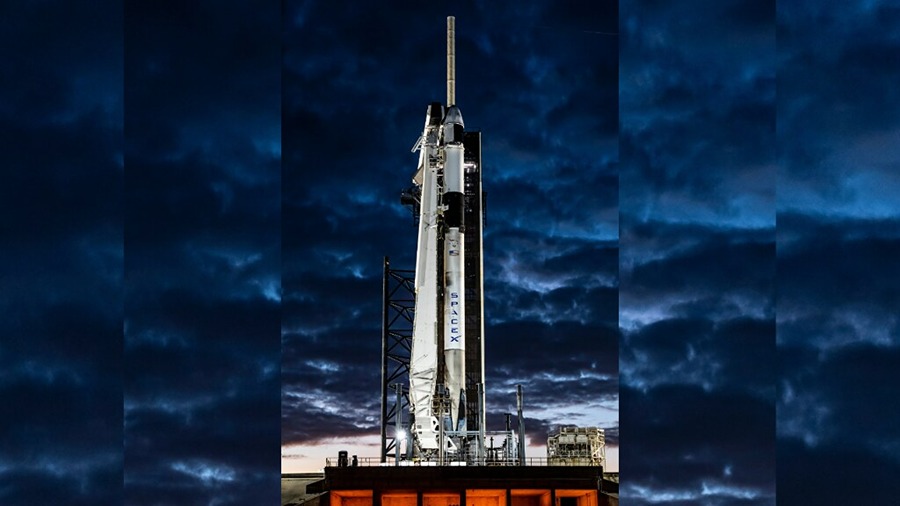
KENNEDY SPACE CENTER, FL, Aug 25, 2025 – SpaceX launched its 33rd commercial resupply services (CRS) mission, funded by NASA on Aug 24, 2025, from Cape Canaveral Space Force Station, sending research and supplies. The flight carries ISS National Laboratory investigations, probing how microgravity changes cells, alloys and autonomous systems – questions that could influence medical therapies.
On this mission, the ISS National Lab continues space-based research aimed at practical outcomes on Earth and progress toward a commercial low-Earth-orbit economy. The investigations include biomedical and physical-science experiments, technology demonstrations, and student-led projects enabled by the station’s laboratory resources.
ISS National Lab-sponsored investigations on this mission include the following:
- Wake Forest Institute for Regenerative Medicine to study engineered liver tissue containing blood vessels in microgravity. This project could advance tissue engineering in space to support future organ replacement for patients on Earth and beyond.
- Cedars-Sinai Medical Center to evaluate whether induced pluripotent stem cells divide faster in space, which could accelerate regenerative medicine. This project builds on multiple investigations from this research team over the years and could further in-space manufacturing capabilities to produce stem cell-based therapies for heart disease and neurodegenerative conditions
- ISS National Lab commercial service provider Axiom Space is partnering with Red Hat, to validate edge computing technologies through the Red Hat device edge platform.
- Student-led projects aim to prepare the space workforce of tomorrow. One project is from the annual Genes in Space competition, in which students in grades 7-12 propose genetics-related investigations to be done on the space station. The project aims to use bacteriophages as therapeutic agents to combat potential microbial infections in space. Higher Orbits Go For Launch! program will send multiple experiments from students in Florida, Michigan, Pennsylvania, Texas, and Virginia.
Source: ISS
About International Space Station (ISS) National Laboratory

The International Space Station is an orbiting laboratory that enables research and technology development not possible on Earth. Operated as a public service, the ISS National Laboratory allows U.S. government agencies, academic institutions, and private-sector organizations to access its microgravity environment, Earth observation capabilities, and space-based conditions to support non-NASA science, technology, and education initiatives. The lab promotes research aimed at improving life on Earth, supporting the growth of commercial space activity, and advancing STEM education. Established in 2005, the ISS National Laboratory has been managed by the nonprofit Center for the Advancement of Science in Space (CASIS), since 2011 under a cooperative agreement with NASA. Headquartered in Rockledge, FL, the lab has supported more than 700 research payloads. In fiscal year 2024, it sponsored over 100 experiments, nearly 80% from commercial users. That year, funding commitments totaled nearly $25M, with STEM outreach and over 50 publications.
About SpaceX

SpaceX, formally Space Exploration Technologies Corp., designs, manufactures and launches rockets and spacecraft. Its fleet includes Falcon 9 and Falcon Heavy rockets and the Dragon spacecraft; it is developing Starship, a reusable heavy-lift system. The company also operates Starlink, a global satellite internet network serving residential, enterprise, mobility, maritime and aviation users. Founded in 2002, SpaceX provides launch services, human spaceflight, cargo transport and satellite connectivity for U.S. government and national-security customers, commercial satellite operators and consumers worldwide. The company is headquartered in Hawthorne, CA, with operations in TX and FL. Production in Hawthorne covers engines, stages and spacecraft assembly; testing is centered in McGregor, TX, and mission operations span multiple launch ranges. Revenue for 2025 is projected at about $15.5B, led by Starlink and a high launch cadence. As of 2025, the company has been in business for 23 years.
