

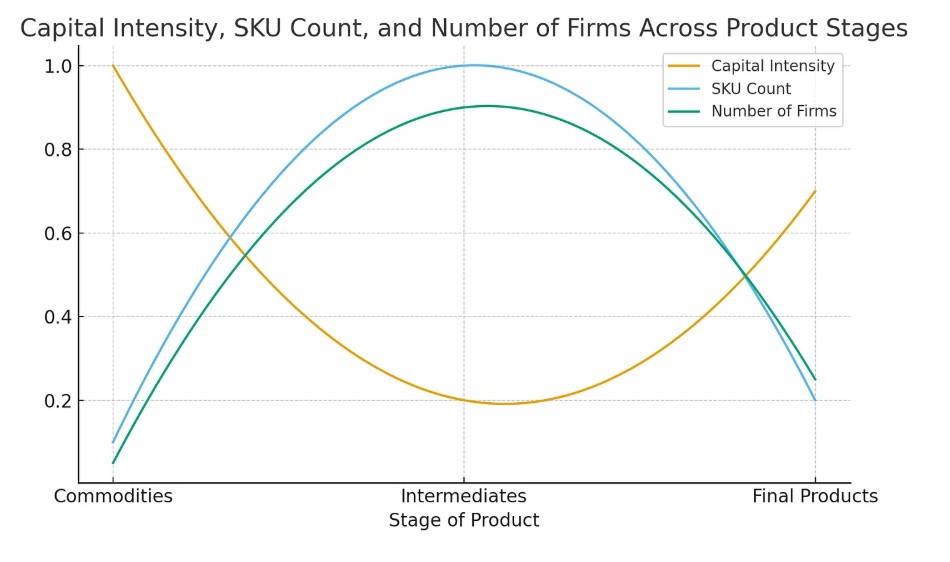
In this article from Austin Vernon’s Substack, the author, Austin Vernon, argues that U.S. manufacturing lags not because of a fundamental absence of capability, but because of outdated business models and slow turnaround in low-volume production. The United States excels in high-volume manufacturing of bulky, static products that benefit from economies of scale, but it performs poorly in producing custom parts with short lead times, a weakness rooted in high “soft costs” such as manual quoting, planning, and administrative friction. Vernon contends that reducing these inefficiencies through digitization would shift cost structures and make low-volume production competitive domestically.
Vernon lays out how traditional manufacturing layers work, noting that intermediate inputs and custom parts often involve weeks or months of delay because of manual processes and fragmented supply chains. He believes the path forward is not more robots or tariff-driven policy, but a software-centric model that automates quotes, integrates customer files directly into production pipelines, and slashes lead times. Firms that adopt end-to-end digital workflows can eliminate much of the office labor that currently drives up costs in custom jobs, making production nearly as fast and affordable as overseas alternatives.
The article highlights examples of companies already succeeding with this strategy. They use instant quoting and automated production planning to convert orders to work schedules with minimal human intervention, cutting turnaround from weeks to days. Vernon sees this shift as a catalyst for broader industrial renewal: faster part delivery accelerates innovation cycles, strengthens supply chains for capital goods and military applications, and could reduce reliance on slow, overseas production.
Policy should support this transition by lowering regulatory friction and talent misallocation rather than pushing heavy industrial subsidies. Vernon views speed and digitization as the competitive advantage that could redefine American manufacturing competitiveness in the 21st century.
