

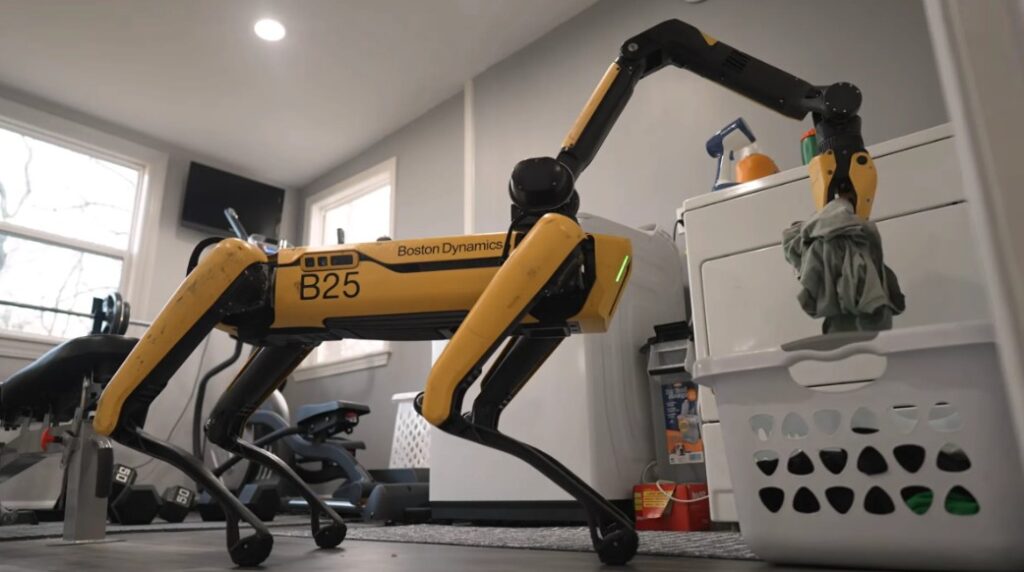
Boston Dynamics’ quadruped robot Spot is taking a significant step beyond scripted automation with the integration of advanced artificial intelligence from Google DeepMind. The upgrade equips the robot with Gemini Robotics-ER 1.6, a high-level embodied reasoning model designed to help machines better interpret and act within complex physical environments, tells IEEE Spectrum.
The focus of this collaboration is not flashy demonstrations but practical industrial work, particularly inspection tasks where Spot has already proven commercially viable. With its new AI capabilities, the robot can autonomously navigate facilities, identify hazards such as debris or spills, and read detailed instruments such as gauges and sight glasses. These tasks previously required either manual oversight or highly structured programming.
What sets this system apart is its ability to combine perception with reasoning. The AI processes visual input, interprets instructions, and determines appropriate actions in real time. This moves Spot closer to human-like understanding, where decisions are shaped not just by predefined rules but by contextual awareness. The goal, according to researchers, is for robots to respond to instructions in ways that align with human expectations, reducing misinterpretation in real-world tasks.
However, this transition also highlights the gap between computational reasoning and practical execution. While the AI can complete tasks such as sorting or handling objects, it may still lack the nuanced physical intuition humans develop through experience. For instance, grasping objects safely or anticipating unintended consequences remains an area for improvement. To address this, developers are incorporating safety-focused reasoning models that guide the robot toward more reliable and context-aware behavior.
Another notable feature is enhanced success detection, where multiple camera inputs help the robot confirm whether it has completed a task correctly. This reduces ambiguity and improves reliability in environments where precision matters.
The broader significance lies in the convergence of robotics and large-scale AI systems. Spot’s evolution reflects a shift from machines that execute commands to systems that interpret, decide, and adapt. While challenges remain, particularly in bridging reasoning and physical interaction, the integration of embodied AI marks a meaningful step toward robots that can operate independently in the real world.
