

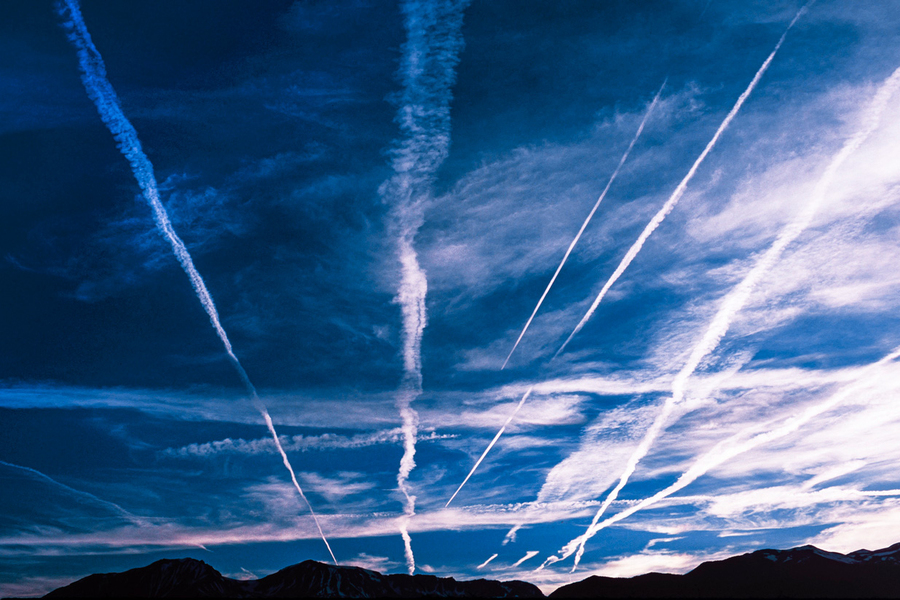
An MIT study suggests that expanding the way we observe aircraft condensation trails, known as contrails, could play a key role in reducing aviation’s climate impact. Contrails form when jet engine exhaust meets cold, humid air high in the atmosphere, creating thin ice-crystal clouds. These trails can trap heat radiating from Earth, giving contrails a net warming effect on the planet that rivals carbon dioxide emissions from flights. To reduce this impact, scientists say we need a clearer picture of where and when persistent contrails form.
Current satellite surveillance relies heavily on geostationary satellites, which hover over fixed points on Earth and provide frequent broad views. But this approach misses many contrails, especially thin or short-lived ones. MIT researchers found that geostationary imagery alone fails to capture roughly 80% of contrails seen by higher-resolution low-Earth-orbit satellites. Without that level of detail, it’s difficult to predict contrail formation accurately or guide aircraft to avoid regions where long-lasting, climate-worsening trails are likely to form.
The article argues for a broader network of “eyes in the sky,” combining data from both geostationary and low-Earth-orbit satellites, along with ground-based observations, to improve contrail detection and forecasting. With better real-time information, flight planners and pilots could adjust altitude or routing to reduce contrail creation, similar to avoiding turbulence. This type of targeted avoidance strategy could significantly lower aviation’s warming effect with small changes in flight paths.
Researchers emphasize that reducing contrails is one of the most effective near-term ways to cut aviation’s climate footprint, complementing other efforts such as low-carbon fuels and engine improvements. But success depends on solid data about contrails, where they are, how long they persist, and when they most strongly trap heat. Expanding satellite surveillance and integrating multiple data sources could provide that foundation.
