

A growing push toward energy-efficient cooling has brought evaporative technologies into sharper focus, but fragmented research has slowed their broader adoption. A recent article from the International Institute of Refrigeration highlights a newly proposed framework designed to standardize how evaporative cooling systems are classified, modeled, and evaluated.
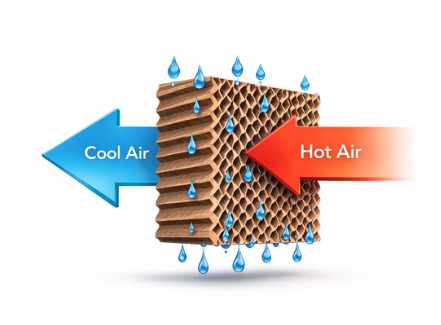
Evaporative cooling works by leveraging a simple physical process: as water evaporates, it absorbs heat from the surrounding air, lowering its temperature. Unlike conventional air-conditioning systems that rely on energy-intensive vapor-compression cycles and refrigerants, these systems consume less energy and avoid greenhouse-gas-emitting chemicals.
Despite these advantages, research in this field has remained inconsistent. Different studies often use varying terminology, system definitions, and datasets, making it difficult to compare performance or validate simulation models. The newly proposed framework addresses this gap by introducing a comprehensive classification of evaporative cooling technologies and providing benchmark datasets for researchers.
The framework categorizes systems into four main types: direct evaporative coolers, which cool air through direct contact with water; indirect systems, which cool air via heat exchangers without adding moisture; dew-point systems, which achieve lower temperatures by recirculating cooled air; and Maisotsenko-cycle systems, which further enhance efficiency through advanced airflow design.
Standardization is expected to accelerate innovation by enabling clearer comparisons between designs and improving the reliability of predictive models. This is particularly important as evaporative cooling gains traction as a sustainable alternative in multiple sectors.
The technology already sees practical use in building climate control, especially in hot and dry regions, where it provides low-energy indoor cooling. It is also applied in industrial processes, data centers, and HVAC systems to reduce energy loads. Beyond buildings, evaporative cooling supports agriculture through greenhouse climate management and post-harvest storage, helping preserve crops. Emerging applications include electronics cooling and hybrid systems that combine evaporative and conventional methods for improved efficiency.
By aligning research methods and definitions, the new framework lays the groundwork for wider adoption of evaporative cooling as a scalable, low-impact solution to rising global cooling demand.
