

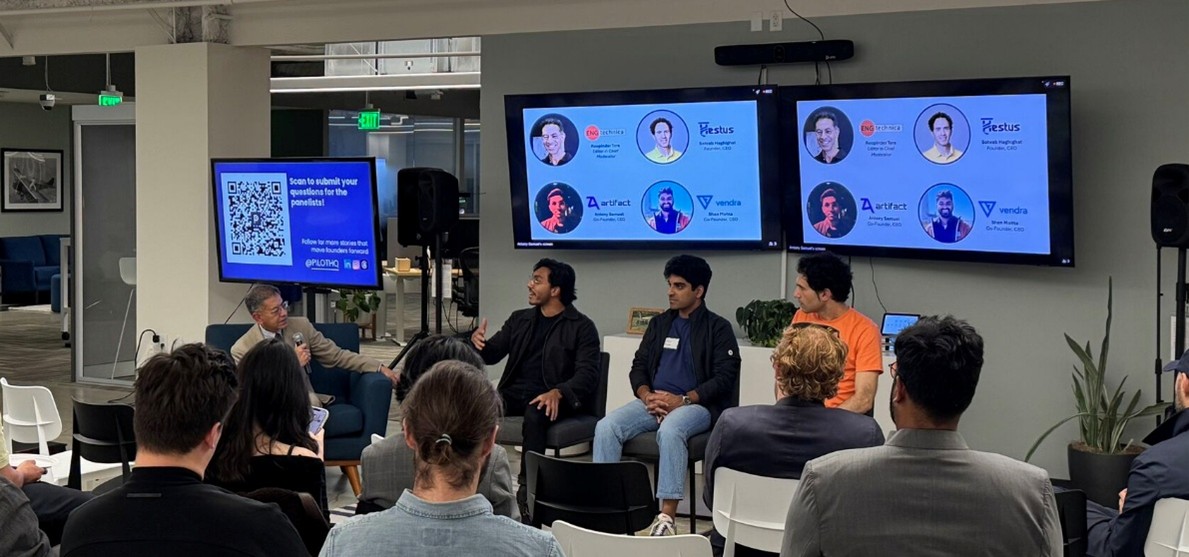
At a San Francisco event titled “From CAD to Craft: AI in Manufacturing,” three founders stepped onto the stage to explain how artificial intelligence is finally finding useful work in engineering. I was there to moderate the conversation. From the ensuing conversation, it became clear that the AI revolution in manufacturing is less about replacing engineers than freeing them to do real engineering.
I admit that I have spent the years since ChatGPT was first introduced impatient with how Big CAD has been dragging its heels in implementing AI.
“All we’ve heard is hype,” I start the session with the obvious. “Engineers have seen what ChatGPT can do — slick answers, but not reliable ones. Enough wrong answers. We stopped trusting it.”
While generative AI dazzled writers and coders, engineers curious about AI came away with caution based on mistrust. LLMs could generate code, but they couldn’t design a part, completely dimension a drawing or understand why tolerance mattered.
AI was language-based, big CAD execs told us. It learned from terabytes of text. But it didn’t understand shapes, physics, or manufacturing constraints and processes.
That’s changing. A new wave of startups — as exemplified by the founders of 3 startups on stage, they are steeped in aerospace, robotics and precision manufacturing. They are applying AI not to words, but to geometry, materials and process data.
Artifact: Collaboration for Complex Electrical Systems
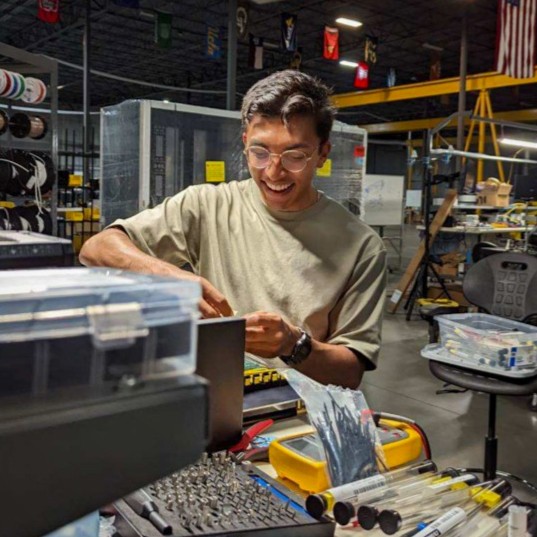
First to be called on was Antony Samuel, CEO and co-founder of Artifact, a platform for designing complex electrical systems — not at the circuit-board level, but across entire vehicles and aircraft.
Antony and his co-founder, Corbin Klett, met while working at Hermeus, the Atlanta-based developer of hypersonic aircraft. “We were both hardcore hardware guys,” Antony said. “Corbin handled the software stack. I handled avionics. We were turning wrenches, laying wire, getting jet fuel on our faces.”
What they discovered at Hermeus — and in nearly every hardware company since — was that the design tools for large-scale electrical systems hadn’t kept up with the way modern teams actually work. “When you’re wiring up a ship or a plane, you’re dealing with tens of thousands of wires,” Antony explained. “The software for collaboration just isn’t there.”
Artifact, launched in early 2024, is meant to fill that gap. Engineers can upload existing drawings, collaborate in real-time, and keep technicians, supply chain, and manufacturing teams aligned. “It’s system-level design for electrical systems,” Antony said. “Not chips, not PCBs — but the network of everything that connects them.”
For now, Artifact’s AI work remains mostly behind the scenes. “We’re getting the atomic units right,” he said. “You have to build VS Code before you build Cursor.” The goal is to let AI handle unstructured data — checking for design-rule violations, spotting wiring conflicts and learning from past builds — without taking control away from engineers.
Vendra: An AI Marketplace for Machined Parts

Next up was Shan Mohta, CEO of Vendra, a manufacturing marketplace specializing in precision-machined parts for the aerospace and defense industries.
Shan is also an engineer by background, with stints at Microsoft, Apple and the autonomous drone company Skydio, where he led camera hardware development. “Every time I tried to get parts made,” he recalled, “it was the same misery — calling suppliers, checking material availability, lead times, capacity. You spend days sourcing, then get hit with delays and bad quotes.”
Vendra’s solution is to let AI do the sourcing. When a customer uploads a CAD model — typically a STEP file — Vendra’s software analyzes it for complexity, materials, tolerances and other manufacturing constraints. Vision models read the accompanying 2D drawings to extract specifications. Then the system matches the part to a supplier with the right capabilities and real-time machine capacity.
“We automate the entire sourcing process,” Shan said. “Emails, phone calls, follow-ups — everything.”
Importantly, Shan doesn’t train its AI on customer CAD data, which is often sensitive or ITAR-controlled. Instead, it learns from feedback loops with suppliers: how long jobs take, how costs vary with complexity, and how materials trend over time. “That data is gold,” Shan said. “It makes our predictions better — not from customer IP, but from actual manufacturing outcomes.”
When asked if toolpath generation — the G-code of machining — might be next, Shan nodded. “It’s on the wishlist,” he said. “Automating toolpaths would close the loop between design and fabrication. But it’s a hard problem — every machine, every tool change adds complexity.”
Hestus: The Co-Pilot for Mechanical Engineers

Then came Sohrab Haghighat, founder and CEO of Hestus, whom I had already had the pleasure of hosting on the “Future of Design and Engineering Software” podcast (to be published soon).
“I built rockets. I built autonomous cars. I designed the landing gear. And every time,” he said, “it took two days to come up with the concept — and a month of misery to get the part right.”
Sohrab’s résumé includes Cruise Automation, where he was among the first ten employees and has years of experience in aerospace manufacturing. The pain he describes is familiar to every mechanical engineer: the endless redesign cycle between design, manufacturing and supply chain.
“Engineers don’t know what’s available, what’s in the supply chain, or what things cost,” he said. “They only find out after they’ve finished the design — and then it’s back to the drawing board.”
His most vivid memory: blowing up an entire test facility with a design oversight. Millions gone. Six months wasted.”
Hestus aims to prevent that. The company is building an AI co-pilot for mechanical design, integrated natively with Autodesk Fusion. The AI handles “the dirty work” — dimensioning, tolerancing, constraint management — while the engineer focuses on creative design. “We do the shitty, repetitive stuff so engineers don’t have to,” he said.
I interject from the moderator’s chair: “As an engineer, I remember getting kicked out of the machine shop for tolerances of a thousandth of an inch. I wish I’d had a tool like this.”
The Data Problem — and Synthetic Solutions
I steered the discussion toward AI’s biggest challenge in engineering: data scarcity. Unlike text-based LLMs, which train on terabytes of web content, engineering models often have access only to small, proprietary datasets.
Sohrab argued that it is not an insurmountable problem. He went on to ask rhetorically, “Why does AI have to be an LLM?” “Engineering has rules. You can generate synthetic data — run CFD or FEA simulations for hours to create training data that’s physically grounded.”
He added that user data, used responsibly, can improve models without compromising privacy. “You don’t spy on customers, but you learn how they use the tool, what works and what doesn’t.”
Shan agreed, explaining that supplier feedback provides a wealth of structured data for training. “When a manufacturer tells us how long a part took or why it failed, that’s high-quality data,” he said. “That’s how you make AI practical in manufacturing.”
The Ethics of Data Use
The panel turned to a question dividing the industry: should customer data ever be used to train AI?
A year ago, every vendor promised, “We’ll never use your data.” Recently, some have changed their tune. “Elon Musk doesn’t apologize for using Tesla’s video data,” I noted.
Shan, whose customers include defense contractors, was firm. “We literally can’t use customer data. The industries we serve — specifically, aerospace and defense — require sandboxed environments. We can’t anonymize and share data across customers. Our intelligence comes from the supplier side.”
Sohrab added a note of realism. “As long as you’re using any cloud-based AI, no guarantee is really a guarantee,” he said. His company is therefore building lightweight, local models that run entirely on the customer’s workstation. “If you unplug the Internet, it still works,” he said. “That’s how you guarantee privacy.”
The Rise of “Physical AI”
I brought up a quote from NVIDIA’s Jensen Huang: “Physical AI — AI grounded in physics — will change the world.”
Unlike language models, physical AI understands mass, force and constraint — why a finger can’t pass through a wall, why a beam bends.
Antony of Artifact sees that shift coming. “In electrical engineering, we’re already simulating reflections on long wires or voltage drops in complex systems,” he said. “As the tech improves, it’s inevitable that AI will start modeling real physics more directly.”
Sohrab, unable to contain himself, told the audience, which looked as if they were developers and startups themselves, to “stop using LLMs for CAD. They’re not built for spatial reasoning.” That elicited some ripples of amusement from the audience and encouraged him to continue.
“You can’t describe geometry in sentences,” he said. “Engineers don’t even know what their design looks like until they start sketching. AI should understand geometry, not language.”
David and Goliath: Competing with the Giants
I turned the spotlight on the competition.
Antony’s Artifact competes in a field long dominated by Siemens (which acquired Mentor Graphics, Cadence, Synopsys…“EDA is ruled by giants,” I said. “Are you not afraid?”
Antony smiled. “They are giants — but they’re also 30 years old. After the Cold War, all the defense companies consolidated and so did their software. These tools were optimized for compliance rather than agility. They’re hard to use because they were built by acquisition — 20 companies bolted together. That’s not how you move fast.”
Vendra faces giants, too — Xometry and Protolabs, for example, as well as manufacturing marketplaces created by the CAD vendors themselves, such as Siemens and Dassault Systèmes. Dassault. But agility is his advantage.
“We can turn around a customer feature in a day,” Shan said. “One afternoon a customer asked for a new quoting filter; by the next morning, it was live.”
I encouraged the underdogs: “They can’t rip out their C++ engines and replace them with AI. Their business models depend on stability. They are being conservative. You’ve got more runway than you think.”
Beyond CAD: The Future of AI-Assisted Design
As the conversation turned to the future, I posed a provocative question: Will CAD itself disappear?
“I can see a world,” I posited, “where I don’t have to design — where I just tell the system, ‘Electrify this car,’ and it handles it all. I still want to be in control, but I want AI to help me with repetitive work, learning and using what I have done.”
Antony agreed: “You’ll see smaller teams building harder things, faster. That’s the promise — fewer people, shorter timelines, more ambitious projects.”
Shan framed AI as an “enablement tool,” not an autopilot, but with humans very much in the loop.
“You wouldn’t get on a plane without a pilot, even though autopilot can land it. Same with design — AI assists, but humans stay in control.”
For Sohrab, the goal is to shrink the team, not the ambition. “At my rocket company, I had 45 people and needed $30 million to keep going. If a tool like this had existed, I could have done it with $10 million. That’s success — building the same thing with a fifth of the people and cost.”
Q&A
The formal panel concluded, but the audience refused to leave, and questions and comments continued to come in for another half hour. I had not seen this intense engagement before. CAD conference Q&A usually features a minimum of journalists’ questions and many questions from analysts. Here are some highlights.
One engineer described trying to use ChatGPT-like tools to model geometry through code. “It does alien things,” he said. “There’s no sanity check.”
This only provoked Sohrab to condemn LLMs again. “Please stop using LLMs for tech prototyping. They’re not made for spatial reasoning. Use models that understand geometry, not language.”
A lively exchange followed on text-to-CAD tools, with one audience member suggesting that AI could at least create starting geometry. Sohrab, of course, disagreed. “If you give a mechanical engineer a non-parametric CAD file, they’ll throw it out. Fixing it takes longer than starting from scratch. Order of operations matters — it’s the designer’s intent.”
I had to step in to do my best to rescue LLMs. “LLMs could still be useful for documentation — remembering commands, generating specs, translating requirements. CAD is complicated; an AI assistant could help navigate it.”
Sohrab backed off a little. “Exactly. LLMs are great at requirements, compliance and reporting — the boring parts engineers hate. But the creative part, the conceptual design — that’s ours.”
Barriers of Format and File
A final question probed one of AI’s most frustrating hurdles: CAD data formats.
Shan admitted the pain. “We hate proprietary part files. We train on STEP because it’s readable text. SolidWorks files? Impossible. There’s too much gatekeeping in this industry.”
Sohrab described how Hestus built its own internal representation — “Hestus Design” — to map and train on Autodesk Fusion’s API. “Every CAD system encodes geometry differently,” he said. “A line in Fusion is two points. In Onshape, it’s a point, length and direction. You have to decode it all to make it interoperable.”
The lack of a universal format, he said, keeps the industry “in prison.”
As the discussion closed, the founders returned to a shared vision: AI that understands the physical world.
“The future isn’t text-to-CAD,” Sohrab said. “It’s CAD-with-AI — systems that understand geometry, manufacturability and physics as they’re being designed.”
AI won’t replace engineers, he argued — it will amplify them. “We have more work than people. The goal isn’t to lay off engineers, it’s to give them superpowers.”
As I thanked the panelists and audience, I tried to establish a tone that was both grounded and hopeful, while also adding caution. “Engineers don’t trust AI at the moment,” I told them, referring to too many wrong answers supplied by LLMs like ChatGPT. From here on in, trust will have to be earned.
In the months and years ahead, if AI truly takes its place alongside CAD and CAM, it will be because of companies like Artifact, Vendra, and Hestus — startups that see AI not as magic, but as machinery: useful, precise, and built to work.
“AI in engineering won’t design airplanes by itself,” I concluded. “But it will make sure the engineers who do can fly higher.”
