

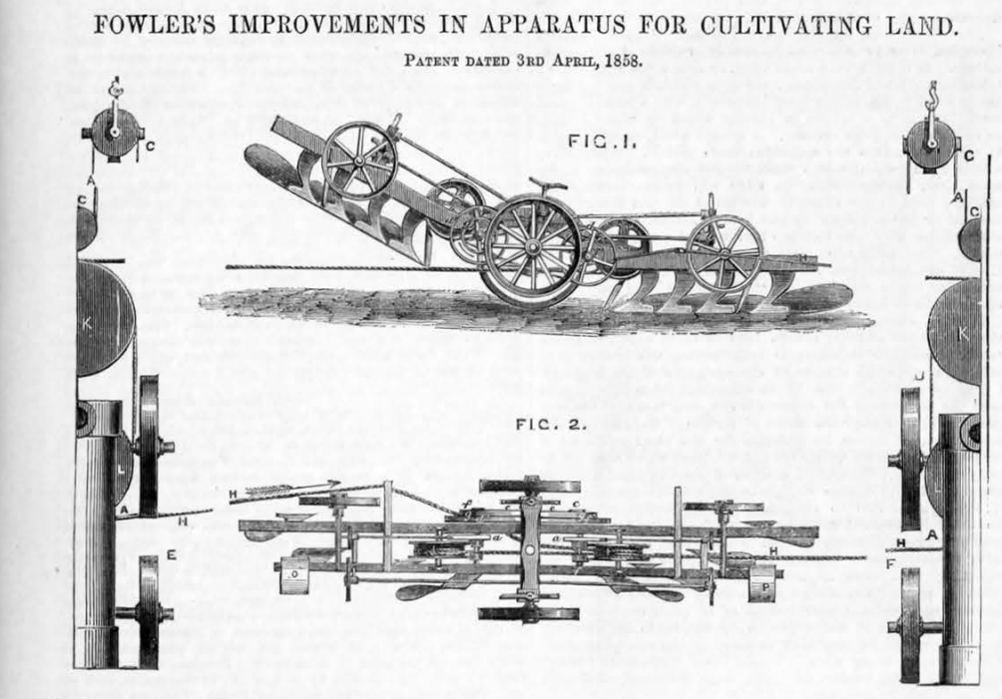
John Fowler was an English agricultural engineer whose steam-powered inventions transformed farming in the mid-19th century. Born in Wiltshire in 1826, he turned his attention to agricultural machinery after seeing the devastation of the Irish potato famine and deciding that better tools might improve food production. His work introduced mechanization to tasks such as ploughing and drainage that had long depended on animal and human labor, tells The Engineer.
Fowler’s early innovations focused on ploughing and land drainage. Between 1850 and 1864, he took out more than thirty patents for ploughs, reaping machines, seed drills, traction engines, and related mechanisms, reflecting a relentless drive to refine and expand his ideas.
His most important contribution was the steam-driven plough. Early steam ploughing attempts using a single engine proved too heavy for wet soil, but Fowler shifted to systems in which stationary or paired steam engines pulled a cable-driven plough back and forth across a field. This method overcame the limitations of draft animals and lighter engines, allowing uniform depth and speed in ploughing and making previously uncultivable land workable.
In 1858, a steam ploughing system Fowler developed won a £500 prize from the Royal Agricultural Society of England for its economy compared with traditional horse teams. Around 1860, his partnership with manufacturers in Leeds led to large-scale production of ploughing engines. By 1861, hundreds of his machines were operating, and his designs were exported globally, spreading steam-powered cultivation far beyond Britain.
Fowler founded John Fowler & Co. in Leeds in the early 1860s; the firm became a major producer of agricultural and traction engines. Although he died in 1864 at age 38, his company continued its work, and steam ploughing remained influential until internal combustion tractors made it obsolete in the early 20th century.
Fowler’s work marked a turning point in agricultural engineering. By harnessing steam power, he helped shift farming toward mechanized processes, increasing efficiency, expanding arable land, and laying groundwork for modern farm machinery.
