

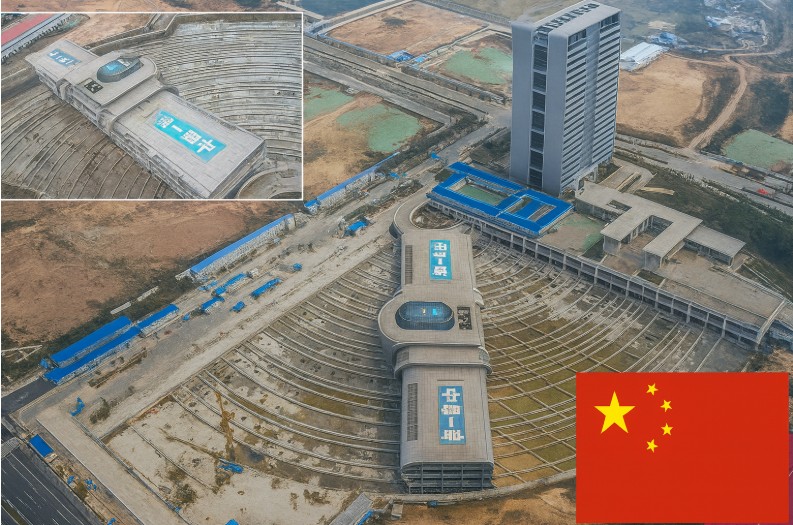
In a major engineering achievement, Chinese construction teams relocated a 30,000-ton bus terminal in Xiamen, Fujian Province, completing the move in just 40 days. The structure, originally built in 2015, was shifted and rotated 90° to clear space for high-speed rail infrastructure, allowing the building to be reused rather than demolished, tells this interesting article on CPG.com.
The project leveraged 532 hydraulic jacks installed on roller tracks, all controlled via a computer system that synchronized movements with millimeter precision. The terminal advanced roughly 7–8 meters per day, eventually covering 288 meters before completing the full 90° rotation.
Cost savings were significant. Rebuilding the terminal elsewhere would have cost much more; instead, the relocation cost around $7.5 million, compared with an estimated four-to-five-times higher expense for demolition and reconstruction. Maintaining the existing structure saved both money and materials, aligning with sustainable engineering practices by avoiding tons of rubble and rebuild waste.
Beyond cost and speed, the initiative sets a new benchmark for adaptive infrastructure. It demonstrates how large, complex buildings can be repositioned rather than discarded when urban-rail expansion or land-use change demands it. The feat was also recorded in the Guinness World Records for the largest building rotation of its size.
This remarkable feat proves that the right combination of mechanical systems, automation, and structural control, even massive concrete terminals, can be moved safely and efficiently. Urban development, especially in dense cities, can benefit from such approaches, preserving assets while adapting to new mobility and land-use needs.
