

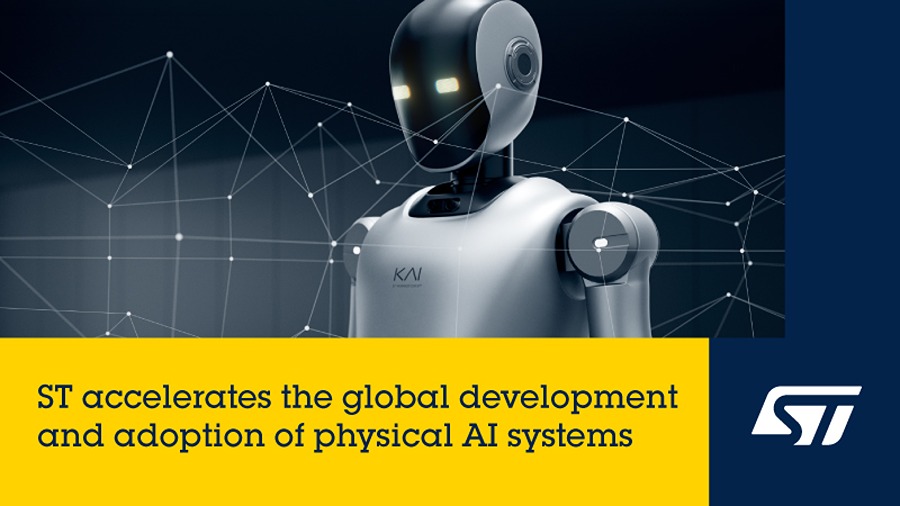
GENEVA, Switzerland, Mar 23, 2026 – STMicroelectronics is integrating its robotics components with NVIDIA platforms to support physical AI systems, including humanoid, industrial, service and healthcare robots. ST is integrating its portfolio with components compatible with the NVIDIA Holoscan Sensor Bridge (HSB) and adding high-fidelity models to NVIDIA Isaac Sim. Initial releases include integration of a Leopard depth camera enabled by ST with the NVIDIA HSB and a high-fidelity model of an ST IMU into NVIDIA’s Isaac Sim ecosystem.
“ST is well engaged within the robotics community, providing robust support and a well-established ecosystem,” said Rino Peruzzi, executive vice president, sales & marketing, Americas & global key account organization at STMicroelectronics. “Our collaboration with NVIDIA aims to unleash the next wave of cutting-edge robotics innovation with developer and customer experience streamlined at every step, from the inception of AI algorithms to the seamless integration of sensors and actuators. This will accelerate the evolution of sophisticated AI-driven physical platforms.”
“Accelerating the development of next-generation autonomous systems requires high-fidelity simulation and seamless hardware integration to bridge the gap between virtual training and real-world deployment,” said Deepu Talla, vice president of Robotics and Edge AI at NVIDIA. “The integration of STMicroelectronics’ sensor and actuator technologies with NVIDIA Isaac Sim, Holoscan Sensor Bridge and Jetson platforms provides developers with a unified foundation to build, simulate and deploy physical AI at scale.”
Simplifying Sensor and Actuator Integration with the Holoscan Sensor Bridge
Developers can use the NVIDIA HSB to standardize and synchronize data from ST sensors and actuators for robotics development. This supports data capture for NVIDIA Isaac models and helps align simulation with real-world system behavior.
ST integrates STM32 microcontrollers, sensors and motor control systems with NVIDIA Jetson platforms. These configurations support humanoid robot designs. One example is Leopard Imaging’s stereo depth camera based on ST imaging and motion-sensing technologies, used across Physical AI OEMs, research groups and industrial robotics applications.
Reducing Cost, Complexity Challenges with High-Fidelity Modeling for Omniverse Isaac
Robotics developers face development costs and modeling complexity. High-fidelity simulations require substantial GPU and CPU resources and large datasets, while selecting randomization parameters requires domain expertise. Poor parameter choices can produce unrealistic scenarios, slow convergence and degrade performance in real-world.
ST and NVIDIA are developing hardware-calibrated models for ST components. The first IMU model is available, with additional models for ToF sensors, actuators and other ICs in development using benchmark data from real ST hardware. These models represent device behavior and integrate with the NVIDIA Isaac Sim ecosystem. The NVIDIA HSB is also being integrated into ST’s toolchain.
ST and NVIDIA state that more accurate models improve robot learning. Models that represent real-world device behavior improve alignment between simulation and deployment. This approach reduces training time, lower the cost of building and supports development of humanoid robotics applications.
Source: STMicroelectronics
About STMicroelectronics

STMicroelectronics (ST) is a semiconductor company founded in 1987. It designs and manufactures microcontrollers, sensors, power devices and other analog and mixed-signal components. The company operates as an integrated device manufacturer with in-house production that supports large-volume supply for global markets. Its customers include automotive, industrial, consumer electronics and communications equipment manufacturers. ST also works with technology partners to develop components used in mobility systems, energy and power management equipment and connected devices. The company reports ongoing efforts to reduce emissions across its operations and increase the share of renewable electricity in its manufacturing sites, with a goal to reach full renewable sourcing by 2027. ST is headquartered in Geneva, Switzerland. It serves more than 200,000 customers worldwide and employs about 50,000 people. Its technologies support applications that require efficient power conversion, sensing, processing and connectivity. The company expands its portfolio to support automotive, industrial, consumer and connected system applications through integrated design and manufacturing.
