

GENEVA, Switzerland, Mar 12, 2026 – STMicroelectronics has introduced an ultra-wideband (UWB) chip family for device localization and tracking over distances of several hundred meters. The UWB chip family support the next-generation wireless standard with greater processing power capability. The platform targets automotive, consumer, and industrial use cases that require secure digital access, presence and motion sensing, and precise approach detection.
The three SoCs (ST64UWB-A100, ST64UWB-A500, and ST64UWB-C100) are built on 18 nm FD-SOI process that improves link budget by nearly 3 dB compared with standard bulk technologies. The improvement extends operating range by about 50% beyond gains already delivered by the IEEE 802.15.4ab standard.
UWB Chips Enable Localization
ST64UWB-A100 – Designed for automotive applications such as digital keys and vehicle localization. The chip includes an Arm Cortex-M85 core and supports an ASIL A(B) automotive safety concept.
ST64UWB-A500 – Adds AI acceleration and digital signal processing to support edge AI radar applications. Target uses include child presence detection (CPD), kick sensing, parking sensors, and radar-based vehicle sentinel mode. The device also uses the 15.4ab Kaiser pulse shape and a 1.3 GHz bandwidth on UWB channel 11 to improve radar accuracy compared with 500 MHz channels.
ST64UWB-C100 – Targets commercial and consumer applications and is built on an Arm Cortex-M85 core. The chip supports hands-free and tap-free user interactions and is compatible with the Aliro standard.
Why IEEE 802.15.4ab and ST64UWB Matter
“The ST64UWB family we announce today is an industry-first system-on-chip supporting the latest ultra-wideband specification, IEEE 802.15.4ab including narrow-band assistance radio, with ultra-precise ranging and sensing,” said Rias Al-Kadi, general manager, ranging and connectivity division, STMicroelectronics. “These chips are tailored for automotive, consumer, and industrial applications, providing innovators with a powerful platform for the next wave of ultra-wideband use cases.”
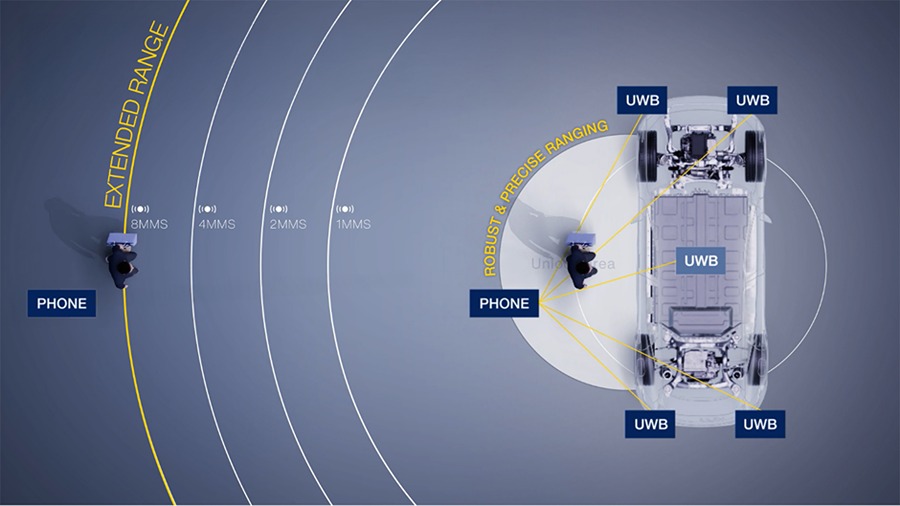
The new standard builds on IEEE 802.15.4z UWB wireless technology used in hands-free digital car keys. Enhancements using multi-millisecond ranging (MMS) and narrowband assistance (NBA) extend operating range and improve connectivity with devices carried in bags or rear pockets. The technology also enables close-range direction finding to help interpret user intent. IEEE 802.15.4ab improves radar mode and supports applications such as child presence detection (CPD) in vehicles, a safety feature recommended by Euro-NCAP.
“IEEE 802.15.4ab is set to become the backbone of next-generation ultra-wideband,” said Andrew Zignani, senior research director at ABI Research. “By 2030, we expect the vast majority of ultra-wideband equipped vehicles to migrate to this new standard, leveraging a rapidly growing installed base of hundreds of millions of compatible smartphones. Meanwhile, backward compatibility with IEEE 802.15.4z allows the industry to adopt these enhancements quickly without disrupting existing deployments, while enabling valuable new user experiences and services across multiple end markets.”
“IEEE 802.15.4ab is the foundation for enabling a new generation of key fobs as part of a digital key system,” said Daniel Siekmann, head of Car Access HW D&D Team, Forvia Hella. “It offers more than eight times the range of 802.15.4z and significantly better non-line-of-sight performance, which allows for key fob functionality to reliably perform from a back-pocket or inside a bag. With backward compatibility to 802.15.4z, it provides a practical path to replace legacy HF/LF key fobs with a modern ultra-wideband based architecture, a transition that is further enabled by STMicroelectronics’ new ST64UWB chips.”
“By adopting 802.15.4ab, car access systems can simultaneously improve performance, cost efficiency, and robustness. The more than eightfold increase in range effectively mitigates back-pocket and other obstructed-signal conditions. At the same time, backward compatibility with 802.15.4z gives OEMs like LGIT the flexibility to either enhance reliability using their existing fixed reference points or reduce the number of reference points to lower overall system cost,” said William Jung, team leader, LG Innotek.
“With IEEE 802.15.4ab, the ability to drastically increase UWB performance, especially when the smartphone is left in the rear pocket, is highly appreciated,” said Bernd Bär, expert product line technology, Marquardt. “At the same time, operating within tight global homologation limits while remaining backward compatible with existing IEEE 802.15.4z ecosystems tremendously extends the applicability of UWB systems.”
“Over the last decade, Nuki has helped establish and shape the smart lock category in Europe. We firmly believe Ultra-Wideband is a transformative technology for precise, hands-free unlocking,” said Jürgen Pansi, chief innovation officer, Nuki Home Solutions. “Together with STMicroelectronics and their ST64UWB solution, we are showcasing how the IEEE 802.15.4ab standard can bring the power of Aliro and UWB to our region.”
ST also introduced a development kit to support UWB adoption. The kit includes a UWB stack (PHY and MAC), a radar toolbox, development boards, antenna reference designs, and application examples for automotive and consumer systems.
Source: STMicroelectronics
About STMicroelectronics

STMicroelectronics (ST) is a semiconductor company founded in 1987. It designs and manufactures microcontrollers, sensors, power devices and other analog and mixed-signal components. The company operates as an integrated device manufacturer with in-house production that supports large-volume supply for global markets. Its customers include automotive, industrial, consumer electronics and communications equipment manufacturers. ST also works with technology partners to develop components used in mobility systems, energy and power management equipment and connected devices. The company reports ongoing efforts to reduce emissions across its operations and increase the share of renewable electricity in its manufacturing sites, with a goal to reach full renewable sourcing by 2027. ST is headquartered in Geneva, Switzerland. It serves more than 200,000 customers worldwide and employs about 50,000 people. Its technologies support applications that require efficient power conversion, sensing, processing and connectivity. The company expands its portfolio to support automotive, industrial, consumer and connected system applications through integrated design and manufacturing.
