

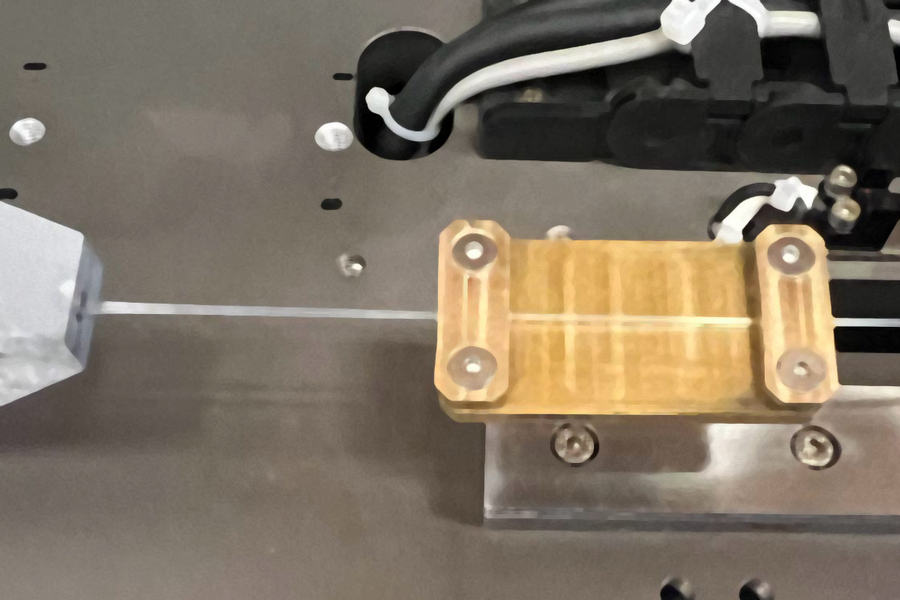
Researchers at the Massachusetts Institute of Technology have engineered a flexible polymer fiber that can swiftly and reversibly change how well it conducts heat simply by stretching it. The material, an olefin block copolymer commonly used in everyday products, normally behaves like a typical plastic with low thermal conductivity. But when the fiber is stretched quickly, its internal molecular structure reorganizes in a way that lets heat move through it more than twice as efficiently. Releasing the tension causes the polymer to return to its original state and insulating behavior. The entire transition takes about 0.22 second, making it the fastest thermal switch observed in any material so far.
At the microscopic level, the polymer is composed of tangled, spaghetti-like chains of molecules interspersed with small regions of more ordered structure. In the unstretched state, the tangled chains impede heat flow. Pulling the material aligns those strands, creating pathways that let heat travel more effectively. Unlike previous efforts with polyethylene, where changes were permanent, the MIT team found this material remains mostly disordered but toggles its state repeatedly without degradation, enabling thousands of cycles of reversible heat switching.
This discovery could have practical applications where dynamic thermal management matters. Fabrics woven with such fibers might cool a wearer on the move by dissipating heat more rapidly when stretched. Electronics and compact devices could integrate the material to shed heat when components heat up, improving performance and lifespan. Adaptive building materials that regulate heat flow in response to structural strain are another potential use.
The research team plans to refine the polymer and explore other materials with similar properties. Their work, published in the journal Advanced Materials, suggests a new class of adaptive thermal materials could be feasible without altering chemical composition, relying instead on mechanical deformation to control heat transport.
