

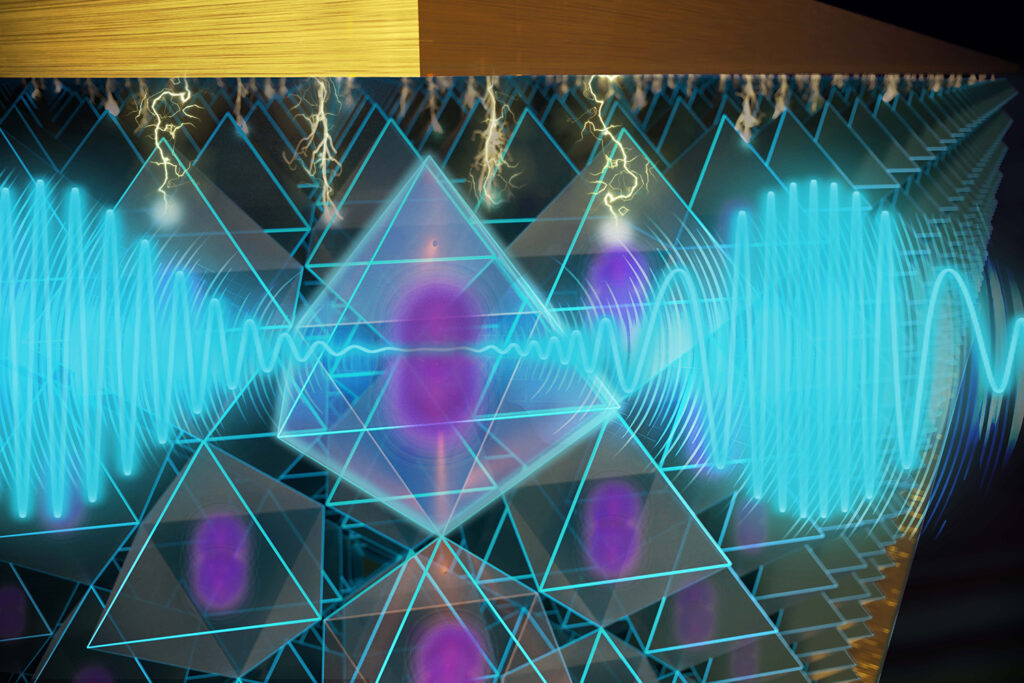
The Stanford engineers show that strontium titanate (STO) outperforms virtually all standard electro-optic and piezo-electric materials when cooled to cryogenic temperatures (around 5 K). Whereas most materials lose their tuning and light-manipulation abilities when chilled, STO’s non-linear optical effects strengthen, and the electro-optic “Pockels effect” becomes roughly 40 times stronger than that of commonly used materials at low temperatures, tells Stanford Report.
In practical terms, this means that electric fields can more strongly modulate light fields, and mechanical deformation under an electric field (piezo-electric response) is much greater than previously seen in low-temperature settings. The material’s exceptional behavior is tied to its quantum paraelectric nature, enabling large dielectric susceptibility, which engineers exploited by isotope engineering and precise film growth to approach “quantum criticality.”
Because quantum computing platforms and space systems often operate at cryogenic temperatures, materials that nicely tolerate these regimes are essential. The Stanford team suggests STO could become a foundational component for light-based switches, quantum interconnects, photonic chips, and mechanical transducers in superconducting or space-based systems.
The novelty lies in repurposing a well-studied, relatively cheap material into a new-regime performer, rather than hunting exotic new compounds. The scientists emphasize the recipe-style: identify materials with a large low-temperature dielectric constant, engineer thin films, tune composition, and strain, and you can unlock novel device capabilities.
For engineers and tech enthusiasts, this work represents a strategic materials advance: rather than incremental chip-scaling improvements, the breakthrough is at the materials system level, enabling smaller, faster cryogenic photonic devices that could shrink and accelerate quantum computer interconnects, or make space-qualified optical systems more efficient.
To sum up, STO may shift from being a niche substrate material to a key enabler of the next wave of photonic and quantum engineering systems.
