

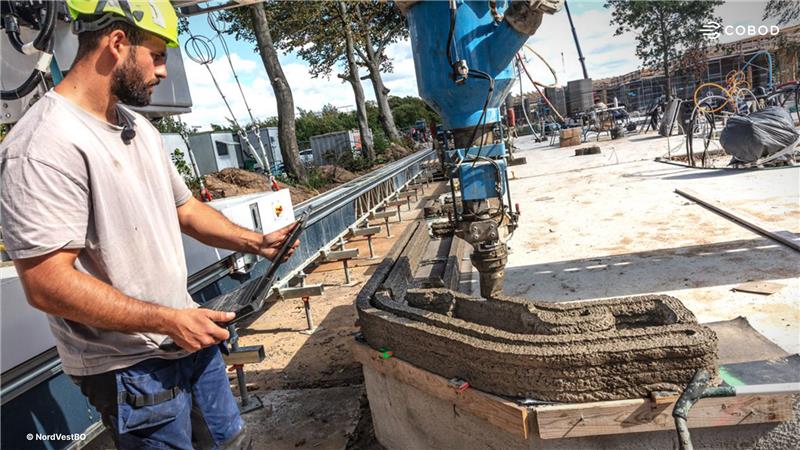
A new construction milestone has been reached with the project Skovsporet (“The Forest Trail”) in Holstebro, Denmark, Europe’s largest 3D-printed housing development so far, tells this article on 3D Printing Industry blog. The build comprises six buildings, each containing six student apartments (total 36 units), with a combined printed footprint of 1,654 m².
The tenant organization, NordVestBo (a Danish affordable-housing association), commissioned the project, executed by 3DCP Group using COBOD International’s BOD3 construction-3D printer system. Each apartment falls in the 40–50 m² range and includes a kitchen, bathroom, study area, and sleeping space.
From a productivity and workflow standpoint, the project shows dramatic improvements: the first building took several weeks to print; by the final building the team completed it in just five days, effectively printing more than one apartment per day. The BOD3’s ground-based track allowed continuous printing along the Y-axis, enabling long wall sections without repositioning the printer.
Sustainability appears integral: the walls are printed with a low-carbon cement mix (FUTURECEM) and timber elements, and the site layout preserves about 95% of existing trees on location.
For engineers and construction professionals, Skovsporet acts as a proof point that 3D concrete printing is moving from novelty to operational scale. The integration of automated printing, material optimization, and modular design threatens to reshape how mid-rise residential structures are built. The next steps will involve interior fit-out and verifying long-term performance, but the printed shells are in place.
This project suggests that for housing sectors where speed, cost, and sustainability matter (student housing, affordable housing), 3D construction printing may be shifting from experimental to mainstream.
