

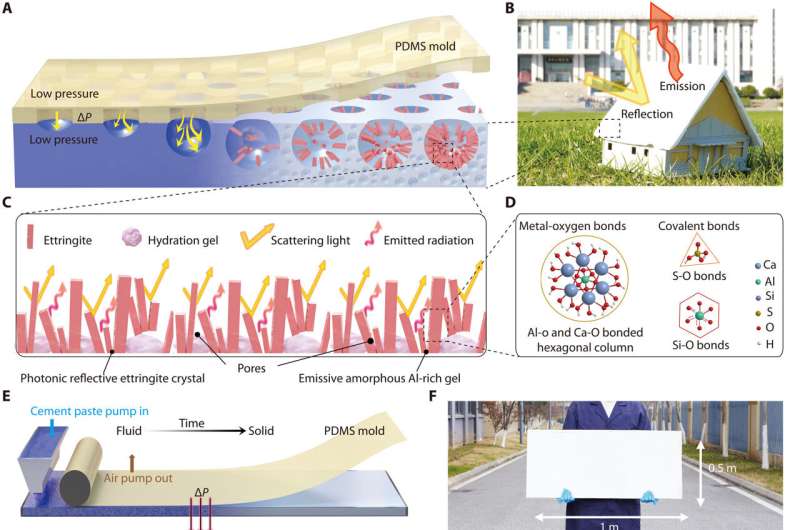
Researchers at Southeast University in China have engineered a groundbreaking super-cool cement that reflects sunlight and emits heat, holding the potential to make the cement industry a negative-carbon emitter rather than a major climate contributor, tells Tech Xplore.
Traditional cement absorbs infrared radiation, heating buildings and driving energy-intensive air conditioning. The newly developed cement, however, incorporates ettringite crystals—grown on its surface through a clever chemical and physical casting process—which act like tiny mirrors and radiators. This allows the material to remain 5.4°C cooler than the surrounding air under strong sunlight, as evidenced by rooftop trials at Purdue University.
Beyond its cooling effects, the cement demonstrates fast-setting strength—able to withstand a dropped iron ball just six minutes after hydration—and has undergone rigorous mechanical, optical, and environmental durability testing.
Most strikingly, machine-learning simulations of the cement’s lifecycle reveal that widespread adoption could result in a net-negative carbon footprint over 70 years. This dual benefit—reducing cooling energy demand while promoting long-term carbon sequestration—positions the innovation as a landmark in energy-efficient, carbon-free construction.
Given that buildings account for roughly 40% of global energy consumption and 36% of carbon emissions, integrating super-cool cement into construction practices could yield substantial climate and urban comfort gains
This reflective, heat-emitting cement, crafted via surface-engineered ettringite crystals, keeps buildings cooler and enables energy savings. Coupled with its demonstrated long-term climate benefits, it opens a transformative pathway toward negative-carbon construction materials.
