

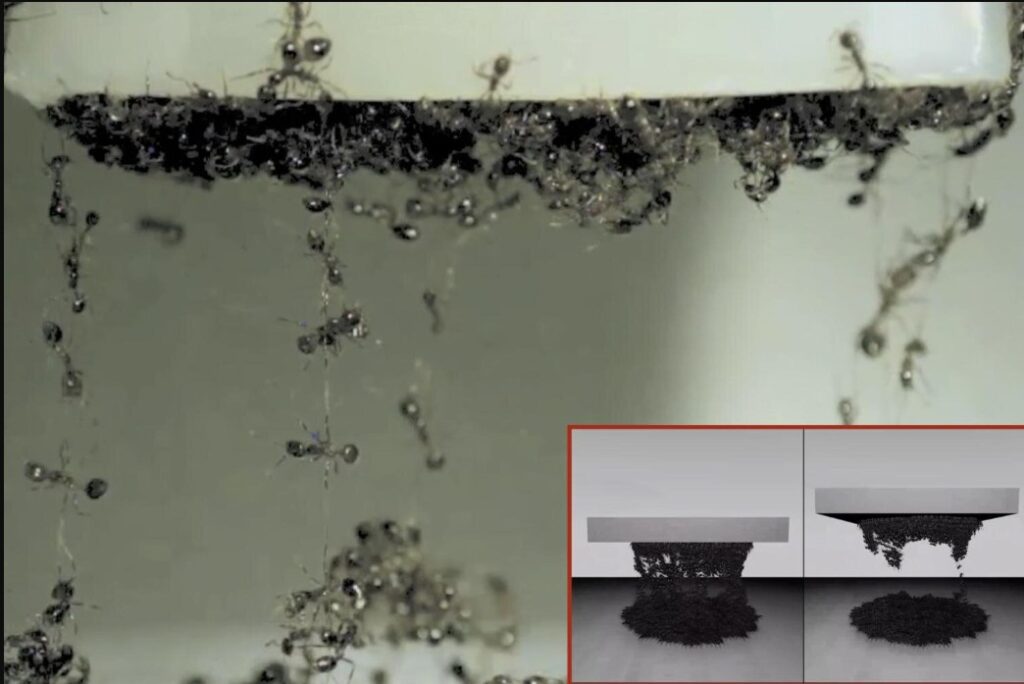
A student-faculty team at New Jersey Institute of Technology (NJIT), led by Matthew Loges and Assistant Professor Tomer Weiss, has developed a computational simulation model based on how ant swarms aggregate. Their work, “Simulating Ant Swarm Aggregation Dynamics,” won best presentation at the ACM SIGGRAPH Symposium for Computer Animation and a poster nomination for the undergraduate competition, tells Tech Xplore.
They observed that ant swarms behave both like fluids and elastic solids: the collective can flow and reform, yet also regain shape after deformation. Using lab experimental data, the researchers built an algorithm that captures these dual properties in simulation.
The implications are broad. In materials engineering, these insights could inspire smart materials; think self-healing concrete that can reform or fill cracks, or materials that adapt shape under stress. In robotics and multi-agent systems, algorithmic control inspired by swarm dynamics may lead to robot teams that navigate more efficiently, adjust formations, or recover from disturbances more smoothly. Traffic control systems could also benefit, using principles of swarm response to optimize flow or adaptively route vehicles.
Beyond practical applications, the project illuminates the value of modeling “active matter” (systems comprised of many individually moving parts) in a way that bridges biology, physics, and engineering. The ant swarm behavior serves as both a model and a metaphor for how complex systems might be controlled or designed.
The work began in mid-2024, with Loges’ interest sparked by a course in computer graphics. Weiss’s expertise helped in combining physics-based simulation, biological observations, and algorithmic modeling.
The simulation shows that mimicking natural swarm elasticity and fluidity isn’t just sci-fi; it has real potential to influence next-generation materials, robotics, and systems design.
