

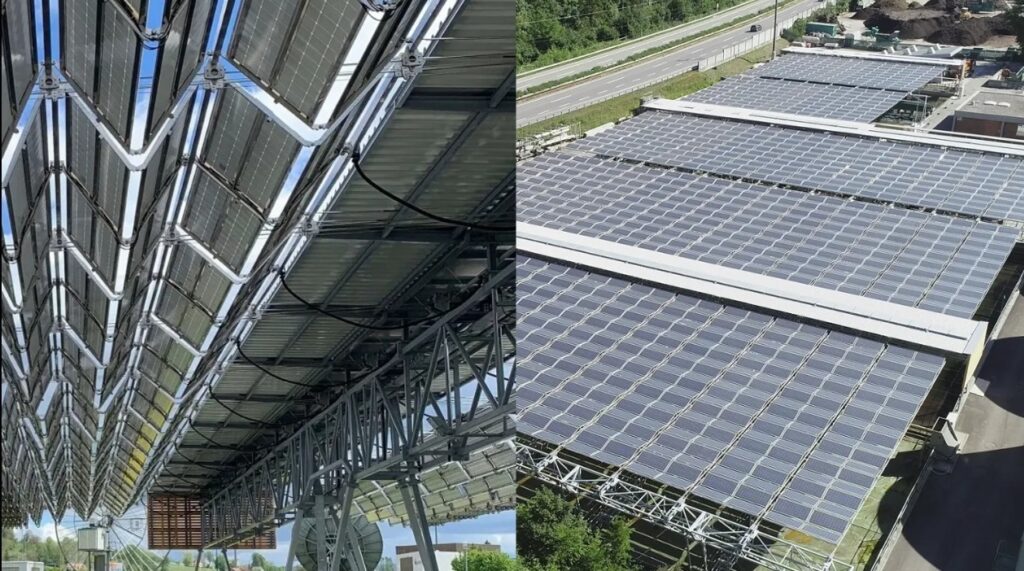
Located above the pretreatment and biological basins at the ARA Thunersee wastewater-treatment facility in Canton Bern, the new system spans about 20,000 m², roughly three football fields, and reaches a peak capacity of approximately 3 MWp. Rather than installing a rigid solar array on open land, the project uses the existing footprint of a public-utility site, turning under-used overhead space into a large-scale energy asset, tells this article from Parametric Architecture.
The technology behind the roof is the HORIZON system developed by dhp technology AG, which combines a cable-supported lightweight structure with a patented folding mechanism. When extreme weather threatens (e.g., high winds or hail), the modules automatically retract into a secure position. This automated retraction reduces structural demands and improves durability, while maintaining accessibility for maintenance of the basins below.
The structure uses up to 50% less material compared with comparable fixed systems, thanks to its cable-based support and truss preassembly. During typical operation, the system is expected to deliver between 3.0 and 3.4 GWh per year, enough to power around 700 households.
For engineers and infrastructure planners, this project signals a shift: solar generation can now be layered over existing utility sites rather than competing for land. Because the canopy folds, it maintains operational access beneath, important for facilities that require maintenance, flow access, or occasional exposure. The combination of structural innovation (folding mechanism + cable support) and energy-generation scale makes it relevant in contexts where land is scarce or high value. The Uetendorf foldable solar roof is an instructive case for integrating large-scale renewables into operational infrastructure without compromising facility performance or occupying new land.
