

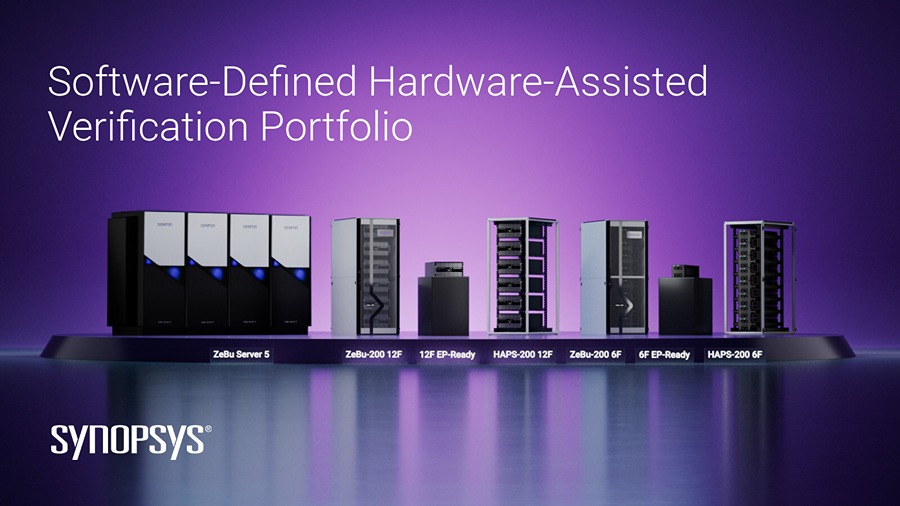
SUNNYVALE, CA, Mar 13, 2026 – Synopsys has introduced new hardware platforms and capabilities in its hardware-assisted verification (HAV) portfolio for AI chip verification. The updates support verification of multi-die and AI semiconductor designs used in data center and edge systems. The HAV platforms address verification workloads linked to increasing chip design size and development timelines.
Verification demands for AI chips are increasing as large language models double in size roughly every four months. Interface data rates are also rising, with speeds doubling about every three years. Edge AI systems introduce additional requirements for throughput, latency, and power efficiency. Together, these factors expand chip design and validation workloads. HAV solutions support broader application coverage and run quadrillions of verification cycles to support silicon validation and integration of heterogeneous AI systems.
“As AI-driven systems become more complex, verification must scale just as quickly. Hardware-assisted verification is no longer optional. It is critical to meeting aggressive time-to-market goals and ensuring silicon readiness,” said Salil Raje, senior vice president and general manager, adaptive and embedded computing group, AMD. “FPGA-based emulation and prototyping play a central role in that effort by accelerating system bring-up and enabling earlier software development. Our collaboration with Synopsys reflects that focus. Through joint optimization of Synopsys ZeBu with the AMD Vivado software stack, and by leveraging AMD EPYC™ processors for compute acceleration, we are reducing compile times and helping customers move to accurate system models faster.”
“As AI becomes more pervasive across almost every industry and products are now workload-optimized and silicon-powered, building high confidence early that the workloads are running to spec on the silicon under development is critical,” said Ravi Subramanian, chief product management officer at Synopsys. “Our software-defined, hardware-assisted verification solutions deliver continuous innovation. They are a powerful force multiplier to scale verification productivity and meet the growing demand for pre-silicon development across industries.”
The newest updates across Synopsys’ software-defined HAV portfolio include:
- Performance and capacity for the AI era: Software-defined updates and modular HAV are available across the ZeBu and HAPS platforms. With these updates, ZeBu Server 5 supports large semiconductor designs used in data center AI training and inference, GPUs, custom accelerators, and networking IPU/DPU workloads. Modular HAV for HAPS supports large prototypes for software development, with updates for compute, storage, and bring-up capabilities.
- New HAPS and ZeBu platforms: The HAPS-200 12 FPGA and ZeBu-200 12 FPGA systems support verification needs for data center sub-system, mobile, client, server, consumer, and edge AI applications. The systems provide 2x higher capacity of previous 6 FPGA platforms and use AMD Versal Premium VP1902 adaptive SoCs, with EP-ready hardware configuration between prototyping and emulation. Synopsys also introduced the HAPS-200 1 FPGA platform as a desktop system for IP verification and software bring-up using Synopsys interface prototyping kits.
“As NVIDIA’s AI platforms have become software‑defined to meet rising performance and scalability demands, verification must evolve in the same way,” said Narendra Konda, vice president, hardware engineering at NVIDIA. “Synopsys’ software‑defined hardware‑assisted verification and the new HAPS‑200 12 FPGA systems are accelerating our system‑level verification and validation, helping us deliver complex AI platforms on aggressive schedules. And, Synopsys modular hardware-assisted verification enables deeper collaboration across our ecosystem.”
- Software-defined HAV capabilities extend system lifetime value: Continuous software updates add verification capabilities and debugging tools for new and installed systems. The Synopsys HAV portfolio includes hardware-assisted test capabilities and automation tools to test corner cases for processor, memory, and I/O subsystems. The tools also support full-system coherency validation and observation of system behavior under workloads in emulation before silicon availability. For mixed-signal and system-level designs, Real-Number Models (RNM) emulation represents analog behavior within digital verification flows for software bring-up. For safety-critical and high-reliability designs, fault emulation capabilities support fault injection and analysis across RTL simulation, emulation, and prototyping.
“Verifying hardware for our highly anticipated rack-scale AMD Helios solution – marked by massive AI scale, complex subsystems, and robust software stacks – demands scalable and versatile verification platforms,” said Alex Starr, corporate fellow, AMD. “The Synopsys software-defined, HAV capabilities with EP-Ready Hardware are critical to how we perform CPU, GPU, and AI subsystems verification as well as full-system validation. Teams can also cover an expanded number of use cases in the pre-silicon phase, encompassing analog, digital, and software design verification using Real-Number Models (RNM) in emulation. As well, the flexibility to reconfigure and reuse hardware across projects and move seamlessly between emulation and prototyping as AI designs grow in both physical size and software stack volume are essential to delivering the high-performance, interoperable AI infrastructure at scale needed to meet the world’s growing AI demands.”
Source: Synopsys
About Synopsys

Synopsys Inc. is a U.S. software and semiconductor technology company founded in 1986. The company develops electronic design automation software, semiconductor intellectual property, and verification tools used to design and test integrated circuits. Its products help engineers design, simulate, verify, and manage semiconductor chips and electronic systems. Synopsys also provides software security testing and engineering analysis tools through internal development and acquisitions. The company serves semiconductor manufacturers, electronics companies, system integrators, and software developers. Its customers operate in industries such as semiconductors, automotive, aerospace, consumer electronics, telecommunications, and data centers. Synopsys is headquartered in Sunnyvale, CA. The company employs about 28,000 people worldwide and serves customers across global technology sectors. Synopsys operates offices across North America, Europe, and Asia.
