

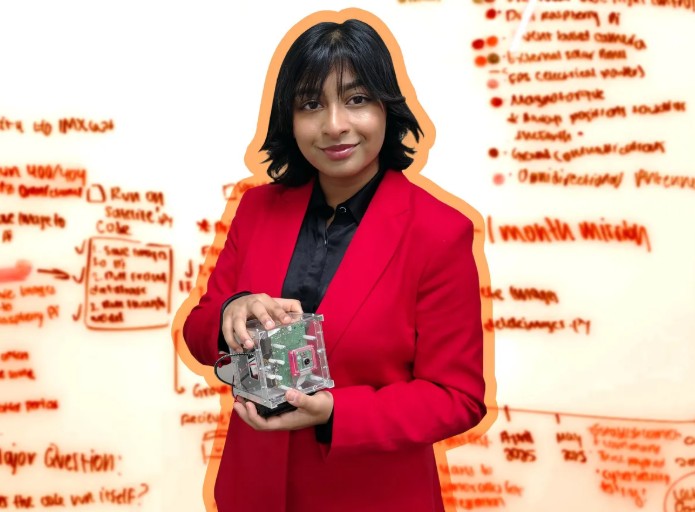
A 15-year-old high school student has developed an AI-integrated CubeSat designed to detect flooding and support emergency response—a project that showcases both innovation and practical impact from young researchers. Abigail Merchant, a sophomore from Orlando, Florida, says frequent flooding in her region and slow delivery of satellite data to first responders motivated her to pursue faster, more reliable methods of flood detection. Floods are becoming more common as climate change increases rainfall intensity, challenging traditional observation and response systems, tells IEEE Spectrum.
Existing flood monitoring relies on satellites with synthetic aperture radar and GPS, but delays in data transmission can cost time during emergency operations. Merchant’s CubeSat addresses that gap by using pattern recognition and onboard processing to detect flooding conditions, assess damage to infrastructure, and track potential survivors. The design fits within standard 10-centimeter CubeSat units, making it modular and compatible with off-the-shelf components for batteries, solar panels, and onboard computers, factors that help keep costs low.
Her work, including design, simulation, hardware configuration, and autonomous software development, was presented at the IEEE Region 3 annual conference, IEEE SoutheastCon. Merchant and her teammates participated in MIT’s Beaver Works Build a CubeSat Challenge, where high schoolers had eight months to design a satellite mission. Merchant’s role focused on programming the payload and shaping the machine learning algorithms that let the CubeSat interpret images in real time using a convolutional neural network (CNN).
The prototype, built for about US $310, weighs roughly 495 grams and has been tested on the ground with Bluetooth connectivity to a laptop. Though further steps remain before orbital deployment, the project illustrates how small satellites with AI can offer near-real-time insights during disasters. Merchant sees CubeSats as scalable tools that could one day form constellations delivering rapid updates to emergency teams worldwide, improving response times, and saving lives.
