

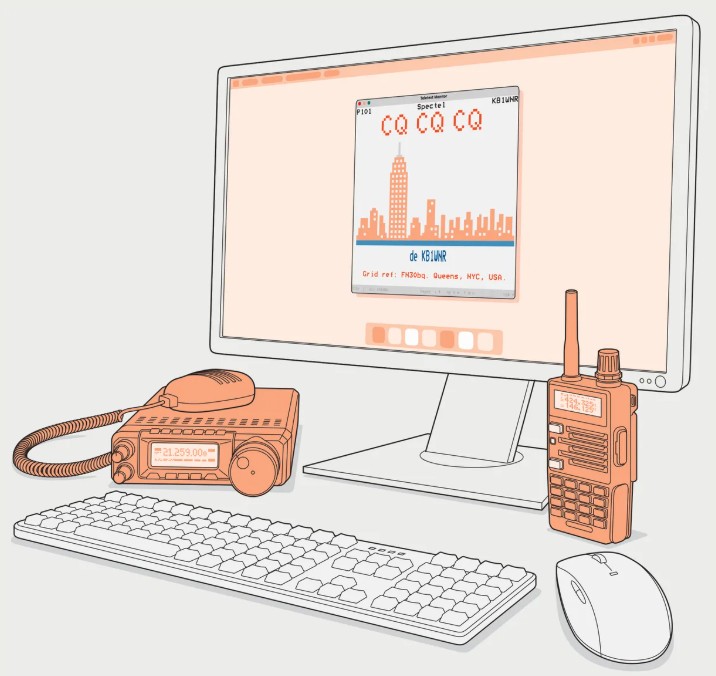
A decades-old broadcast technology is finding new life in an unexpected place: amateur radio. The IEEE Spectrum article explores a project that revives teletext, a system widely used in the 1980s to transmit text-based information over television signals, and adapts it for modern ham radio communication.
Teletext originally allowed viewers to access news, weather, and other data through simple, blocky graphics embedded in analog TV signals. The revived version uses similar principles but transmits data over radio frequencies instead of television broadcasts. By encoding text and images into radio signals, hobbyists can send and receive structured information without relying on internet connectivity.
The project demonstrates how relatively simple hardware can recreate this system. A computer generates teletext-style pages, which are then converted into audio signals and transmitted using standard amateur radio equipment. On the receiving end, another computer decodes the signal and reconstructs the visual content. This approach makes use of widely available components, emphasizing accessibility and experimentation.
One of the key advantages is resilience. Because the system operates independently of the internet, it can function during outages or in environments where connectivity is restricted. This makes it appealing not only for hobbyists but also for emergency communication scenarios, where reliable data transmission is critical.
The revival also highlights the enduring relevance of older technologies. Teletext’s simplicity and efficiency make it well suited to low-bandwidth communication, offering a contrast to modern, data-heavy systems. By combining retro concepts with contemporary tools, engineers are exploring alternative ways to share information across decentralized networks.
Ultimately, the project is less about nostalgia and more about possibility. It shows that innovation does not always require entirely new technologies; sometimes it involves rethinking and repurposing existing ones to meet modern needs, especially in a world where connectivity cannot always be taken for granted.
